
 EN
What Are the Common Mistakes When Buying Solar Systems?
Buying a solar energy system is a major investment for any business. Whether you operate a factory, warehouse, hotel, supermarket, or agricultural facility, the right solar solution can reduce electricity costs, improve energy reliability, and protect your operations from power interruptions.
However, choosing a solar system involves much more than comparing equipment prices or checking the total installed capacity. A system that looks attractive on a quotation may turn out to be expensive to operate if its inverter is incorrectly sized, its battery capacity does not match the actual load, or its components are not properly integrated.
For commercial and industrial buyers, these mistakes can lead to unexpected costs, poor system performance, and unnecessary maintenance.
Based on practical experience in commercial solar project design and implementation, this guide explains four common mistakes buyers should avoid when purchasing solar systems for industries and other commercial applications.
1. Choosing a Solar Energy System Based Only on the Lowest Price per Watt
One of the most common mistakes when buying solar energy systems is focusing too heavily on the lowest price per watt.
When comparing supplier quotations, buyers often calculate the cost based on the rated capacity of the solar panels. A lower price per watt may seem like a good deal, especially when purchasing a large commercial system. However, the lowest initial purchase price does not necessarily mean the lowest long-term energy cost.
A commercial solar system is not simply a collection of solar panels, inverters, and batteries. It is an integrated energy solution designed to generate, convert, store, and distribute electricity according to a site's specific operating requirements.
For example, two suppliers may both quote a 100kW solar system, but their solutions may differ significantly in several areas:
- Inverter capacity and performance: Does the inverter support the site's actual load requirements, including motor starting currents and peak demand?
- Battery capacity: Is the storage system large enough to support the required backup duration?
- System architecture: Can solar power, battery storage, the utility grid, and diesel generators work together effectively?
- Component compatibility: Are the batteries, inverters, protection devices, and monitoring systems properly matched?
- After-sales support: Is technical assistance available when the system needs troubleshooting or maintenance?
Consider a factory that operates heavy machinery. If the buyer selects an inverter based only on its rated power without checking motor starting currents, the system may experience overload alarms or unexpected shutdowns when equipment starts.
Similarly, choosing a battery based only on its price per kWh may result in insufficient backup capacity or an unsuitable operating strategy.
This is why commercial buyers should compare the total system configuration, expected energy output, operating costs, maintenance requirements, and service support—not just the initial quotation.
A useful financial indicator is the Levelized Cost of Energy (LCOE), which considers the total cost of generating electricity over a system's lifetime, including investment, operation, maintenance, and energy production.
What buyers should do: Ask suppliers to provide a complete technical proposal showing the system configuration, estimated daily energy generation, battery storage capacity, expected backup duration, and major equipment specifications. A transparent proposal makes it much easier to compare different suppliers on an equal basis.
2. Incorrectly Sizing Inverters and Energy Storage Based on Incomplete Load Information
Incorrect system sizing is another common mistake in commercial and industrial solar projects.
An inverter should not be selected simply because its rated capacity matches the total power of the solar panels. Its capacity must be determined by the electrical loads it needs to support, the system architecture, and the operating conditions.
Understand the Difference Between Load Power and Energy Consumption
Before choosing a solar system, buyers need to understand two important measurements:
- Power (kW): The amount of electricity equipment requires at a particular moment.
- Energy (kWh): The amount of electricity consumed over a period of time.
For example, a factory may have a connected load of 80kW but consume 500kWh of electricity per day. The inverter must be designed to handle the operating load and peak demand, while the PV array and battery capacity must be evaluated according to daily energy consumption, sunlight conditions, and backup requirements.
These two figures serve different purposes and should not be used interchangeably.
Consider Peak Loads and Motor Starting Currents
Industrial facilities often operate equipment such as pumps, compressors, air conditioners, production machinery, and conveyor systems.
Some of these devices require a much higher starting current than their normal operating current. If the inverter cannot handle the temporary surge, it may trigger overload protection or fail to start the equipment.
For this reason, a proper load assessment should consider:
- Total connected load
- Actual operating load
- Peak demand
- Motor starting current
- Operating hours
- Three-phase load balance
- Critical loads that must remain powered during an outage
A solar system designed for a warehouse with relatively stable daytime demand will have different requirements from one serving a factory with heavy motors and variable production schedules.
Match Battery Capacity to the Required Backup Time
Battery sizing requires the same level of attention.
An undersized battery may be discharged more deeply or more frequently than intended, potentially accelerating capacity degradation. On the other hand, an oversized battery bank may increase the initial investment without delivering meaningful additional value if the stored energy is rarely used.
A practical battery assessment should consider:
- Daily energy consumption during backup periods
- Required backup duration
- Battery chemistry and usable capacity
- Recommended depth of discharge (DoD)
- Battery charge and discharge power
- Charging opportunities from solar panels, the grid, or a generator
- Temperature and ventilation conditions
For example, a commercial facility that needs to maintain lighting, security systems, servers, and essential production equipment during grid interruptions may not need to back up every electrical load. Separating critical and non-critical loads can help optimize battery investment.
Design Solar Power as Part of a Reliable Energy Architecture
The concept of redundancy in data center design offers a useful lesson for commercial solar buyers.
According to the Uptime Institute, Tier III data centers are designed to allow planned maintenance of capacity components and distribution paths without interrupting IT operations. This is a maintainability requirement, not simply a measure of annual downtime. Solar power alone cannot guarantee the same level of availability because photovoltaic generation depends on sunlight and weather conditions.
For businesses that require continuous electricity, a more reliable approach is to integrate solar panels, battery storage, the utility grid, and backup generators into a coordinated energy system.
A well-designed hybrid solar system can prioritize solar power when available, charge batteries when appropriate, and use the grid or generator when additional power is required.
The objective is not simply to install enough solar panels. It is to ensure that the entire energy system can support the facility's actual operating requirements.
What buyers should do: Provide suppliers with a detailed load list, daily operating schedule, peak demand information, and required backup duration. If possible, share electricity bills, generator operating records, and equipment nameplates. These details help engineers design a system based on real operating conditions rather than assumptions.
3. Overlooking the Manufacturing Quality Behind Solar Energy Systems
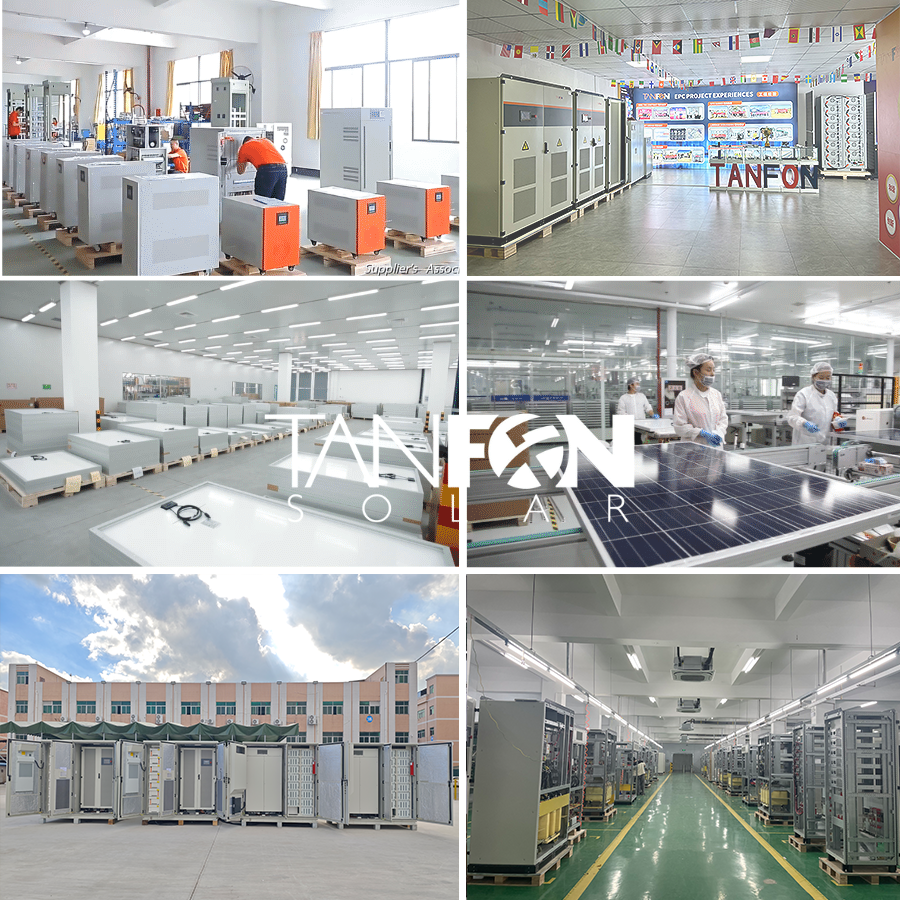
When purchasing a solar system, buyers usually pay close attention to product specifications, brand names, and equipment prices. However, the manufacturing and quality-control processes behind the products are just as important.
Solar modules, inverters, and battery systems are manufactured, assembled, tested, and shipped long before they arrive at the project site. Problems that are difficult to identify during a simple visual inspection may affect system performance after installation.
This is why buyers should look beyond product datasheets and understand how suppliers manage manufacturing quality.
Check the Standards and Certifications Behind the Products
International standards provide an important reference when evaluating solar equipment.
For example:
- IEC 61215: Covers design qualification and type approval testing for terrestrial photovoltaic modules. It evaluates module performance under specified test conditions, but its test results should not be interpreted as a precise prediction of actual service life.
- IEC 61730: Addresses photovoltaic module safety qualification, including construction requirements intended to reduce electrical, fire, and mechanical safety risks.
These standards serve different purposes. Buyers should check the actual certificates, test reports, product models, and certification scope rather than relying only on general claims such as "IEC certified."
Understand the Role of Factory Quality Control
In addition to product certification, manufacturing inspection is important.
For solar modules, electroluminescence (EL) testing can help identify hidden defects such as cell cracks and certain soldering or interconnection problems that may not be visible during ordinary visual inspection.
Depending on the manufacturer's production process, EL inspection may be performed at different stages, including before and after lamination.
For inverters and battery systems, quality control should also cover electrical performance, component compatibility, protection functions, and communication between system components.
For commercial solar systems, buyers should pay particular attention to:
- Component traceability and production records
- Electrical and functional testing
- Battery management system (BMS) protection
- Inverter and battery compatibility
- Communication and monitoring tests
- Packaging and transportation protection
A well-controlled manufacturing process helps reduce the risk of defects reaching the project site. It also makes troubleshooting easier because equipment specifications and production records can be traced when problems occur.
Why System Integration Matters as Much as Individual Component Quality
Even high-quality components cannot guarantee good system performance if they are incorrectly matched or configured.
For example, the battery voltage range must be compatible with the inverter. The inverter's charging and discharging parameters must also match the battery manufacturer's requirements. In a hybrid system, the control strategy should coordinate solar generation, battery charging, grid supply, and generator operation.
This is particularly important for solar systems for industries, where an unexpected power interruption can affect production schedules, equipment operation, and business revenue.
At TANFON, commercial solar solutions are designed around the actual application, load profile, and site conditions. The company's hybrid system architecture can integrate solar generation, lithium battery storage, and backup generators according to project requirements.
TANFON also emphasizes manufacturing quality, component compatibility, and system testing before delivery. Buyers can discuss the specific inspection procedures and available test records with the engineering team when evaluating a project proposal.
What buyers should do: Ask suppliers for product certificates, relevant test reports, quality-control procedures, and system compatibility information. Do not judge a manufacturer's reliability solely by the appearance of its products or the efficiency figures printed on a datasheet.
4. Treating a Solar Energy System as a One-Time Purchase
Perhaps the most overlooked mistake is treating a solar energy system as a one-time equipment purchase rather than a long-term energy investment.
A commercial facility does not remain unchanged after installation. Production capacity may increase, new equipment may be added, electricity prices may fluctuate, and operating schedules may change.
At the same time, solar panels, inverters, and batteries have different maintenance requirements and service lifecycles.
A system designed only for the facility's initial electricity demand may become insufficient as the business grows.
Plan for Future Expansion
Before purchasing a commercial solar system, buyers should consider whether the design can accommodate future changes.
For example:
- Can additional solar panels be installed later?
- Can the inverter support the planned system expansion?
- Is there sufficient space for additional battery cabinets?
- Can the electrical distribution system handle future capacity?
- Can the energy management system support additional equipment?
Not every system can be expanded simply by adding more panels or batteries. Inverter limits, battery communication protocols, DC voltage ranges, protection devices, and electrical design must all be considered in advance.
Planning for expansion at the beginning can help avoid unnecessary reconstruction and additional costs later.
Use Monitoring to Identify Problems Early
A monitoring system is another important part of long-term operation.
Without performance monitoring, buyers may not notice that a PV string is generating less electricity than expected, that a battery is not charging properly, or that an inverter has recorded repeated alarms.
A monitoring platform can help operators track important operating data, including:
- Daily and monthly PV generation
- Battery state of charge (SOC)
- Battery charging and discharging power
- Grid electricity consumption
- Generator operating status
- Load consumption
- System alarms and operating events
By comparing actual performance with expected operating conditions, maintenance teams can identify unusual changes and investigate potential problems before they develop into more serious failures.
However, monitoring alone does not replace physical inspections. Connections, cables, ventilation, mounting structures, and electrical protection devices still require appropriate maintenance.
Choose a Supplier with a Clear Service and Maintenance Plan
A solar system's long-term value depends not only on the equipment but also on the support available after delivery.
Before signing a contract, buyers should clarify:
- Who provides technical support after installation?
- Is remote troubleshooting available?
- How are system alarms handled?
- Is on-site assistance available in the project country?
- What are the warranty terms for different components?
- Are spare parts and replacement components available?
- Can the system be inspected and maintained periodically?
These questions are especially important when purchasing solar systems for industries in regions where grid reliability, transportation conditions, and access to technical support may vary significantly.
Why Africa Experience Matters for Commercial Solar Projects
For projects in Africa, local operating conditions should be considered during system design and service planning.
High ambient temperatures, dust, unstable grid voltage, generator dependence, and long distances between project sites can all influence equipment selection, installation requirements, and maintenance strategies.
A solution that works well in one country or facility may require adjustments before it can be applied to another location.
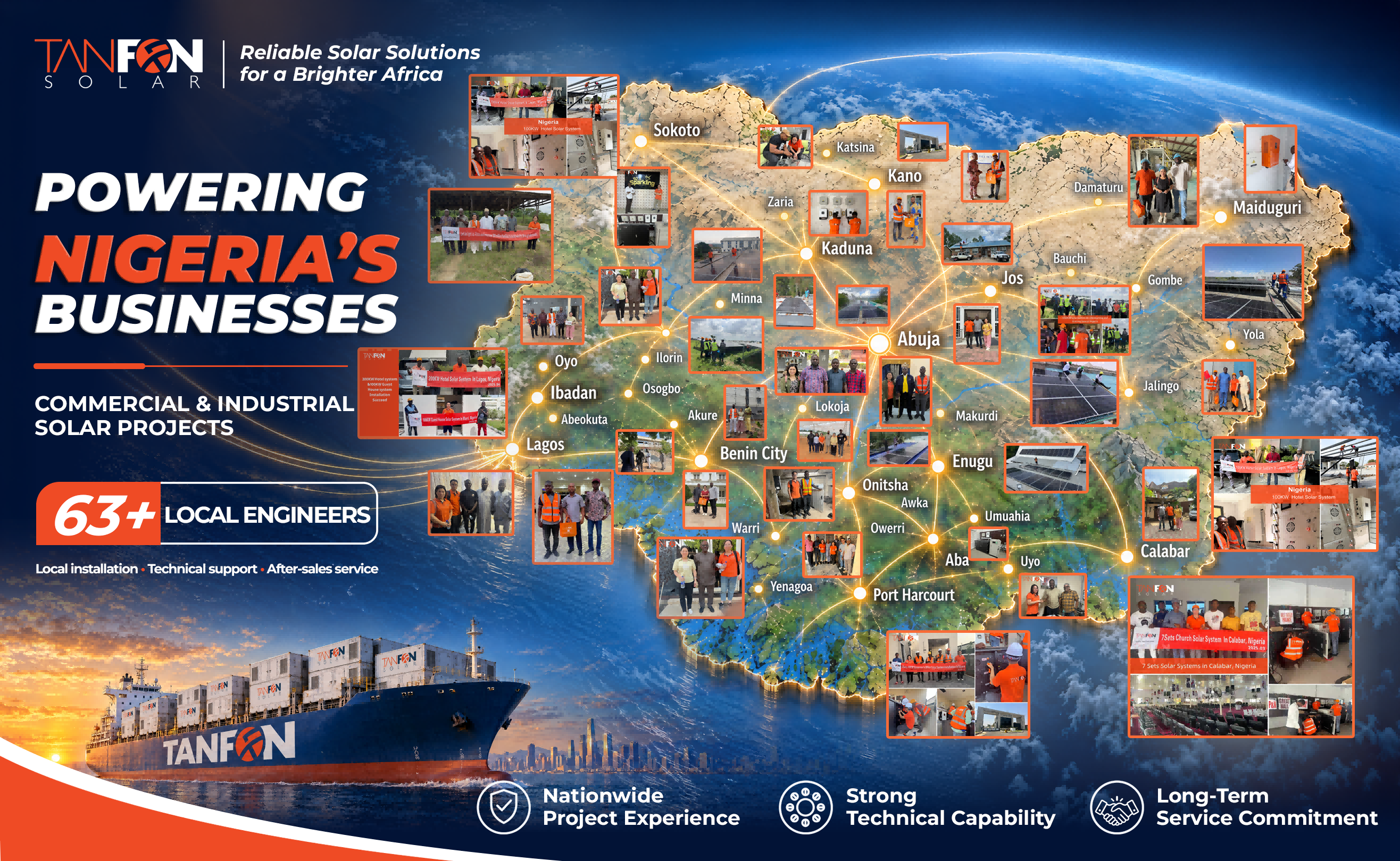
TANFON has extensive experience in Africa, supporting solar projects for factories, hotels, farms, schools, offices, and communities. The company's team has conducted on-site surveys at more than 1,200 locations in Africa and developed over 3,300 project proposals based on customers' electricity requirements.
Its engineers have also completed project work in countries including Nigeria, Chad, the Democratic Republic of the Congo, Kenya, Tanzania, Zambia, and Liberia.
This project experience helps the engineering team understand practical challenges such as unstable grid supply, diesel generator integration, high-power equipment requirements, and the need for reliable remote support.
For buyers, this experience is valuable because system design should reflect the actual project environment—not simply follow a standard configuration used in another market.
What buyers should do: Choose a supplier that can explain its maintenance process, monitoring capabilities, warranty coverage, and local or regional support arrangements. For projects in Africa, ask whether the supplier has relevant project experience and a practical plan for technical support after delivery.
A Practical Checklist Before Buying a Commercial Solar System
Before making a purchasing decision, use the following checklist to evaluate whether a proposed system is suitable for your business.
|
Evaluation Area |
Questions to Ask Your Supplier |
|
Energy consumption |
Has the supplier reviewed actual electricity bills and load data? |
|
Inverter sizing |
Can the inverter handle peak loads and motor starting currents? |
|
Battery storage |
Does the usable battery capacity meet the required backup duration? |
|
System compatibility |
Are the inverter, battery, BMS, and energy management system compatible? |
|
Power architecture |
How will solar, batteries, the grid, and diesel generators work together? |
|
Product quality |
Can the supplier provide relevant certifications and test records? |
|
Monitoring |
Can you monitor generation, battery status, grid consumption, and system alarms? |
|
Future expansion |
Can the system be expanded without major reconstruction? |
|
Warranty |
Are warranty terms clearly defined for each major component? |
|
After-sales service |
Who provides remote support and on-site assistance when needed? |
A supplier who can answer these questions with clear technical information is more likely to understand the actual requirements of your project.
Frequently Asked Questions
1. What is the most common mistake when buying a commercial solar system?
One of the most common mistakes is choosing a system based mainly on the lowest price or the total solar panel capacity. Buyers should evaluate the entire system, including inverter sizing, battery storage, load requirements, component compatibility, and after-sales support.
2. How do I know what size solar system my factory needs?
Start by collecting your electricity bills, daily energy consumption, peak demand, operating hours, and equipment load information. For facilities with heavy machinery, motor starting currents and three-phase load balance should also be considered. A qualified engineering team can use these details to calculate the appropriate PV capacity, inverter rating, and battery storage.
3. Do all commercial solar systems need battery storage?
No. The need for battery storage depends on the project's objectives and operating conditions. A grid-connected system may focus on reducing daytime electricity consumption, while a hybrid or off-grid system may require batteries to provide backup power or support operations when solar generation is unavailable.
4. Why is a hybrid solar system suitable for businesses in Africa?
Many commercial facilities in Africa experience unstable grid supply or rely heavily on diesel generators. A properly designed hybrid solar system can coordinate solar panels, lithium batteries, the utility grid, and backup generators to improve energy reliability and reduce generator operating hours. The actual benefits depend on the site's load profile, solar resource, system configuration, and operating strategy.
5. What should I check before choosing a solar system supplier?
Check the supplier's manufacturing capability, product certifications, system design experience, project references, component compatibility, warranty terms, monitoring platform, and after-sales service. For industrial and commercial projects, it is also important to confirm whether the supplier can provide customized engineering support for your specific application.
Final Thoughts: Choose a Solar Solution for Long-Term Business Value
Buying a commercial solar system should never be just about finding the lowest price or the highest advertised capacity.
The right solution starts with an accurate understanding of electricity consumption, followed by proper inverter and battery sizing, reliable component integration, controlled manufacturing quality, and a clear long-term maintenance plan.
For businesses investing in solar systems for industries, these factors directly affect system reliability, operating costs, and the overall return on investment.
With extensive experience in Africa and a project portfolio covering factories, hotels, farms, schools, and other commercial applications, TANFON provides customized solar energy solutions based on real site conditions and customer requirements.
If you are planning a commercial or industrial solar project, share your load details, electricity bills, and backup requirements with the TANFON engineering team. We can help evaluate your energy needs and develop a suitable solar solution for your business.
TANFON Solar – Reliable Energy Solutions for Commercial and Industrial Applications.
Table of Contents
- What Are the Common Mistakes When Buying Solar Systems?
- 1. Choosing a Solar Energy System Based Only on the Lowest Price per Watt
- 2. Incorrectly Sizing Inverters and Energy Storage Based on Incomplete Load Information
- 3. Overlooking the Manufacturing Quality Behind Solar Energy Systems
- 4. Treating a Solar Energy System as a One-Time Purchase
- A Practical Checklist Before Buying a Commercial Solar System
-
Frequently Asked Questions
- 1. What is the most common mistake when buying a commercial solar system?
- 2. How do I know what size solar system my factory needs?
- 3. Do all commercial solar systems need battery storage?
- 4. Why is a hybrid solar system suitable for businesses in Africa?
- 5. What should I check before choosing a solar system supplier?
- Final Thoughts: Choose a Solar Solution for Long-Term Business Value
