
 EN
EN
What Is the Difference Between On-Grid and Off-Grid Solar?
For many business owners, investing in solar energy starts with one important question:
Should I choose an on-grid solar system or an off-grid solar system?
At first glance, the answer may seem straightforward. An on-grid system connects to the public utility network, while an off-grid system operates independently. However, when planning a commercial solar project, the decision is far more complex than simply determining whether the grid is available.
The type of solar system you choose will directly affect your electricity costs, energy security, return on investment, system maintenance, and even your ability to keep operations running during a power outage.
For businesses such as hotels, factories, warehouses, hospitals, shopping centers, schools, and agricultural facilities, uninterrupted electricity is often essential. A few hours without power can result in production delays, dissatisfied customers, damaged inventory, or significant financial losses. Selecting the right solar solution therefore becomes a strategic business decision rather than simply an equipment purchase.
Over the past two decades, commercial solar technology has evolved rapidly. Traditional grid-tied systems are no longer the only option. Modern businesses can now choose from three primary types of solar energy systems, each designed to meet different operational requirements and energy goals.
Understanding the differences between these systems is the first step toward making an informed investment.
Understanding the Three Main Types of Solar Energy Systems
Although solar installations vary in size and configuration, nearly every commercial project falls into one of three categories:
- On-Grid Solar Systems
- Off-Grid Solar Systems
- Hybrid Solar Systems
Each solution has its own advantages, limitations, and ideal applications.
On-Grid Solar Systems
An on-grid solar system is connected directly to the public electricity network. During daylight hours, solar panels generate electricity to power the building, while any additional electricity required is automatically supplied by the utility grid.
This type of system is designed primarily to reduce electricity bills and maximize the return on investment where utility power is stable and reliable.
Off-Grid Solar Systems
An off-grid solar system operates independently of the utility grid. Electricity generated during the day is stored in batteries and used whenever solar production is unavailable, such as at night or during cloudy weather.
These systems are commonly installed in remote locations where grid access is unavailable or unreliable.
Hybrid Solar Systems
A hybrid solar system combines the advantages of both on-grid and off-grid technology.
Instead of relying on a single energy source, the system intelligently integrates solar panels, battery energy storage, the utility grid, and, when required, a diesel generator. This intelligent energy management ensures continuous power while optimizing operating costs.
For modern commercial buildings, a 3 phase hybrid solar system has become one of the most practical and reliable solutions. It supports three-phase electrical loads, stores excess solar energy for later use, and automatically switches between different power sources according to real-time operating conditions.
This flexibility makes hybrid systems particularly suitable for hotels, factories, hospitals, warehouses, shopping malls, office buildings, and other businesses where uninterrupted power is essential.
Choosing between these three options is not simply a matter of comparing equipment specifications. It requires understanding your building's electricity consumption, operating schedule, local grid reliability, and long-term business objectives.
In the following sections, we'll examine each system in detail, compare their strengths and limitations, and explain why an increasing number of businesses are choosing hybrid solutions for long-term energy security and lower operating costs.
What Is an On-Grid Solar System?
An on-grid solar system, also known as a grid-tied solar system, is a solar power solution that operates in conjunction with the public utility grid. Instead of working independently, the system continuously exchanges electricity with the grid, allowing businesses to maximize the use of solar energy while relying on utility power whenever additional electricity is required.
For commercial buildings with a stable grid connection, an on-grid system is often the most cost-effective way to reduce electricity bills and improve long-term energy efficiency.
Unlike off-grid systems, an on-grid solar system typically does not require large battery storage. During daylight hours, electricity generated by the photovoltaic (PV) array is supplied directly to the building's electrical loads. If solar production exceeds demand, excess electricity may be exported to the utility grid where local regulations support net metering or feed-in tariffs. When solar generation is insufficient, the building automatically imports electricity from the grid without interrupting daily operations.
This seamless interaction between solar generation and utility power makes on-grid systems particularly attractive for businesses with predictable daytime electricity consumption.
How Does an On-Grid Solar System Work?
Although every project is different, the operating principle remains straightforward.
A typical on-grid system includes the following components:
- Photovoltaic (PV) solar panels
- Grid-tied inverter
- Mounting structure
- AC distribution system
- Monitoring platform
- Utility grid connection
During the day, solar panels convert sunlight into direct current (DC) electricity. The inverter then converts this electricity into alternating current (AC), allowing it to power lighting, office equipment, production machinery, air-conditioning systems, and other electrical loads within the building.
Whenever solar production is lower than the building's demand, electricity is automatically supplied by the utility grid. This transition occurs within milliseconds and requires no manual intervention.
For businesses located in countries with reliable electrical infrastructure, this operating model offers an excellent balance between investment cost and energy savings
Advantages of an On-Grid Solar System
One reason on-grid systems remain popular worldwide is their simplicity. Without the need for large battery banks, the system architecture is relatively straightforward, resulting in lower installation costs and reduced maintenance requirements.
Lower Initial Investment
Battery storage is often the most expensive component of a commercial solar project. Because on-grid systems generally operate without batteries, the overall project cost is significantly lower than that of hybrid or off-grid systems.
For businesses primarily seeking to reduce electricity bills, this lower capital investment often results in a faster return on investment.
Higher System Efficiency
Since electricity generated by the solar panels is consumed immediately by the building, very little energy is lost through battery charging and discharging processes.
This direct consumption improves overall system efficiency while maximizing the utilization of available solar energy.
Reduced Electricity Costs
Commercial buildings usually consume the largest amount of electricity during normal business hours—precisely when solar generation is at its highest.
Factories operate production lines.
Office buildings run computers and HVAC systems.
Shopping malls rely on lighting and air conditioning.
Warehouses operate conveyors and logistics equipment.
Because these loads coincide with peak sunshine hours, businesses can significantly reduce their dependence on expensive utility electricity.
Remote Monitoring and Smart Management
Modern on-grid systems are equipped with intelligent monitoring platforms that allow facility managers to track system performance in real time.
Users can monitor:
- Solar energy production
- Daily and monthly electricity generation
- Building electricity consumption
- Carbon emission reductions
- System operating status
- Historical performance reports
These insights help businesses optimize energy management while simplifying preventive maintenance.
Limitations of an On-Grid Solar System
Despite its many advantages, an on-grid solar system is not suitable for every business.
Its biggest limitation becomes apparent during a utility power outage.
No Backup Power During Blackouts
Many business owners assume that solar panels will continue producing electricity whenever the sun is shining.
In reality, standard grid-tied inverters automatically shut down when the utility grid fails.
This safety feature—known as anti-islanding protection—prevents electricity from flowing back into damaged power lines while utility workers are performing repairs.
Although essential for public safety, it also means the building loses power during a blackout, even if the solar panels are capable of generating electricity.
For businesses operating in regions where grid failures are common, this limitation can significantly affect daily operations.
Limited Energy Independence
Because electricity cannot be stored without batteries, businesses remain dependent on the utility grid whenever solar production decreases.
Cloudy weather, nighttime operation, or unexpected increases in electricity demand all require power to be imported from the grid.
For facilities where uninterrupted power is essential, this dependence may present operational risks.
Where Is an On-Grid Solar System the Best Choice?
An on-grid solar system performs best where utility infrastructure is stable and reliable.
Typical applications include:
- Office buildings
- Government facilities
- Universities and schools
- Shopping centers
- Commercial office parks
- Manufacturing plants with reliable utility service
- Distribution warehouses
- Retail stores
These businesses generally experience predictable daytime electricity demand while maintaining access to dependable utility power.
When an On-Grid Solar System May Not Be Enough
Although on-grid systems offer excellent economic benefits, they are not always the best solution for commercial facilities operating in developing markets.
Across many parts of Africa, Southeast Asia, Latin America, and island regions, frequent grid interruptions remain a significant challenge. Hotels, hospitals, factories, and industrial facilities often cannot afford unexpected downtime, even if power outages last only a few minutes.
In these situations, reducing electricity costs is only one objective. Maintaining continuous operations becomes equally important.
This is precisely why many commercial projects are now moving beyond traditional grid-tied systems and adopting 3 phase hybrid solar systems, which combine solar generation, battery storage, utility power, and backup generators into a single intelligent energy management solution.
In the next section, we'll explore how off-grid solar systems work, where they deliver the greatest value, and why they remain the preferred option for remote locations without reliable utility access.
What Is an Off-Grid Solar System?
An off-grid solar system is a self-sufficient power generation solution that operates independently of the public utility grid. Unlike an on-grid system, it does not rely on external electricity to keep a building running. Instead, it generates, stores, and manages its own energy using solar panels, battery storage, and intelligent power control equipment.
For businesses located in remote areas—or regions where utility power is unavailable or highly unreliable—an off-grid solar system provides complete energy independence and long-term operational security.
Today, off-grid systems are widely used in hotels, mining camps, agricultural facilities, telecom stations, island resorts, healthcare centers, and industrial sites where uninterrupted electricity is essential.
How Does an Off-Grid Solar System Work?
An off-grid solar system generates electricity during daylight hours and stores excess energy in batteries for use whenever solar production is unavailable.
A typical commercial off-grid system consists of:
- High-efficiency photovoltaic (PV) panels
- MPPT solar charge controllers
- Hybrid or off-grid inverter
- Battery Energy Storage System (BESS)
- Intelligent Energy Management System (EMS)
- Backup diesel generator (optional)
During the day, solar panels supply electricity directly to the building while simultaneously charging the battery bank. After sunset—or whenever solar production decreases—the batteries automatically discharge to power the building without interrupting normal operations.
If prolonged cloudy weather or unusually high electricity demand causes battery capacity to fall below a predefined threshold, an integrated diesel generator can start automatically to recharge the batteries and maintain continuous power.
This intelligent energy management strategy ensures that critical business operations remain unaffected even when weather conditions change unexpectedly.
Advantages of an Off-Grid Solar System
For many commercial projects, the greatest advantage of an off-grid system is not simply reducing electricity costs—it is eliminating dependence on an unreliable utility network.
Complete Energy Independence
Because the system generates and stores its own electricity, businesses are no longer affected by scheduled load shedding, unexpected blackouts, or poor grid infrastructure.
This level of energy independence is especially valuable in remote regions where extending utility power lines would be prohibitively expensive.
For hotels, hospitals, and industrial facilities operating around the clock, reliable electricity directly supports customer satisfaction, operational efficiency, and business continuity.
Reliable Backup Power
Unlike standard grid-tied systems, an off-grid system continues operating even when there is no public electricity supply.
Battery storage automatically provides power during nighttime operation and periods of poor weather, while intelligent generator integration offers an additional layer of protection for critical facilities.
This makes off-grid solar particularly suitable for applications where even short interruptions can result in financial losses or safety risks.
Lower Diesel Consumption
Many businesses in Africa, Southeast Asia, and island regions rely heavily on diesel generators as their primary source of electricity.
Although diesel generators provide dependable backup, they also introduce high fuel costs, frequent maintenance requirements, noise pollution, and carbon emissions.
A properly designed off-grid solar system significantly reduces generator operating hours by allowing solar energy and battery storage to meet most daily electricity demand.
In many commercial projects, diesel consumption can be reduced by more than 60%, resulting in substantial long-term operating cost savings.
Long-Term Cost Stability
Fuel prices fluctuate constantly, making energy costs difficult to predict.
Solar energy, however, is free once the system has been installed.
Although an off-grid solar system requires a higher initial investment than an on-grid system, many businesses achieve stable long-term electricity costs while protecting themselves from future increases in fuel prices.
Challenges of an Off-Grid Solar System
Despite its many advantages, an off-grid system also presents several design challenges that should not be overlooked.
Higher Initial Investment
Battery Energy Storage Systems (BESS) represent a significant portion of the overall project cost.
Unlike an on-grid system, an off-grid installation must include sufficient battery capacity to supply electricity overnight, during periods of low solar irradiance, and throughout unexpected weather events.
The larger the required backup time, the greater the battery investment.
System Design Is More Complex
Designing an off-grid solar system involves much more than selecting solar panels.
Engineers must carefully evaluate:
- Daily electricity consumption
- Peak electrical demand
- Battery autonomy
- Solar irradiance
- Seasonal weather patterns
- Future load expansion
- Generator operating strategy
Oversizing the system unnecessarily increases project cost, while undersizing may lead to insufficient backup power.
Professional load analysis is therefore essential before determining equipment specifications.
Battery Management Is Critical
Battery performance directly affects system reliability.
For commercial applications, lithium iron phosphate (LiFePO₄) batteries have become the preferred choice because they offer:
- Long cycle life
- Excellent thermal stability
- Deep discharge capability
- Low maintenance requirements
- Enhanced operational safety
When combined with MPPT charge controllers and intelligent energy management systems, LiFePO₄ batteries deliver dependable long-term performance for demanding commercial environments.
Typical Commercial Applications
Off-grid solar systems are commonly installed where utility infrastructure is unavailable or unreliable.
Typical applications include:
- Remote hotels and eco-resorts
- Island tourism facilities
- Mining camps
- Telecommunications stations
- Rural hospitals and healthcare centers
- Agricultural irrigation projects
- Remote manufacturing plants
- Border security facilities
- Community electrification projects
These projects share one common requirement: electricity must remain available regardless of grid conditions.
Real-World Example
One of our hospitality projects clearly demonstrates the value of an off-grid approach.
A remote hotel located on an island relied almost entirely on diesel generators for electricity. Fuel transportation costs were high, generator maintenance was frequent, and guests regularly experienced power interruptions during peak tourist seasons.
Following a comprehensive load assessment, a solar energy system integrating photovoltaic generation, battery storage, and intelligent generator control was installed.
During normal operation, solar energy supplies the hotel's daytime electricity demand while simultaneously charging the battery bank. At night, the batteries power guest rooms, lighting, refrigeration equipment, security systems, and other essential loads. The diesel generator starts only when prolonged periods of poor weather reduce battery capacity below a predetermined level.
The result was a dramatic reduction in diesel consumption, quieter hotel operations, lower maintenance costs, and significantly improved power reliability for guests.
Is an Off-Grid Solar System Always the Best Choice?
Not necessarily.
While off-grid systems provide complete energy independence, they are not always the most economical solution for commercial buildings that already have access to utility electricity.
Many businesses today require more flexibility than either a purely on-grid or purely off-grid system can provide.
Hotels, factories, hospitals, shopping malls, and large office buildings often need to reduce electricity costs while maintaining uninterrupted operations whenever the grid becomes unstable.
For these businesses, a 3 phase hybrid solar system combines the strengths of both approaches—using solar power as the primary energy source while intelligently coordinating battery storage, the utility grid, and backup generators to deliver the highest level of reliability and operational efficiency.
In the next section, we'll explore why hybrid technology has rapidly become the preferred choice for commercial and industrial solar projects around the world.
What Is a Hybrid Solar System?
As commercial energy demands continue to grow, many businesses are discovering that neither a traditional on-grid solar system nor a fully off-grid system can meet all of their operational requirements.
An on-grid system delivers excellent electricity savings but stops supplying power during a utility outage. An off-grid system provides complete energy independence but requires a larger investment in battery storage and system capacity.
This is where a hybrid solar system offers the best of both worlds.
A hybrid solar system intelligently combines solar panels, battery energy storage, the utility grid, and, when necessary, a diesel generator into one integrated power management solution. Instead of relying on a single energy source, the system automatically selects the most efficient and economical power source based on real-time operating conditions.
For commercial and industrial facilities, this approach delivers three key benefits:
- Lower electricity costs
- Reliable backup power
- Greater energy independence
As electricity prices continue to rise and grid reliability becomes increasingly uncertain in many regions, hybrid technology has become one of the fastest-growing segments of the commercial solar industry.
How Does a Hybrid Solar System Work?
Unlike conventional solar systems, a hybrid system continuously monitors multiple energy sources and automatically determines which source should supply electricity at any given moment.
A typical commercial hybrid system consists of:
- High-efficiency PV modules
- Hybrid inverter
- MPPT charge controllers
- Battery Energy Storage System (BESS)
- Utility grid connection
- Intelligent Energy Management System (EMS)
- Backup diesel generator (optional)
The system continuously evaluates:
- Solar generation
- Battery State of Charge (SOC)
- Building load demand
- Grid availability
- Electricity tariffs
- Generator operating status
Based on these variables, the EMS automatically switches between energy sources without interrupting the building's operation.
For example:
During the Day
Solar panels generate electricity to supply the building's electrical loads.
If solar production exceeds demand, the excess energy is stored in the battery system.
During the Evening
Once solar generation stops, the batteries automatically provide electricity to the building.
Occupants experience no interruption because the transition happens seamlessly.
During Grid Failures
If the public utility grid goes offline, the hybrid inverter isolates the building from the grid while continuing to power critical loads using solar panels and battery storage.
If battery capacity becomes low during prolonged outages, the diesel generator starts automatically and operates only as long as necessary.
During High Electricity Tariffs
In regions with time-of-use electricity pricing, the system can charge batteries during low-cost periods and discharge stored energy when electricity prices are highest.
This strategy helps businesses reduce demand charges while maximizing the value of every kilowatt-hour produced.
Why Businesses Are Choosing a 3 Phase Hybrid Solar System
Modern commercial buildings rarely operate on single-phase electricity.
- Hotels.
- Factories.
- Hospitals.
- Shopping malls.
- Warehouses.
- Office buildings.
- Schools.
Manufacturing facilities.
Almost all of these operate using three-phase electrical systems, which are designed to support large motors, elevators, pumps, industrial machinery, HVAC equipment, and other high-power loads.
For this reason, a 3 phase hybrid solar system has become the preferred solution for commercial applications.
Unlike residential solar systems, commercial facilities often experience uneven power demand across the three electrical phases.
Kitchen equipment may operate primarily on one phase.
Air-conditioning systems on another.
Production machinery on a third.
This condition is known as a three-phase unbalanced load.
If the inverter cannot properly manage these load differences, the result may include:
- Voltage fluctuations
- Reduced equipment efficiency
- Unexpected inverter shutdowns
- Higher maintenance costs
- Damage to sensitive electrical equipment
Professional 3 phase hybrid solar systems are specifically designed to support 100% three-phase unbalanced loads, ensuring stable voltage across all phases even when electricity demand changes continuously.
This capability is one of the primary reasons why commercial buildings increasingly prefer hybrid technology over conventional grid-tied systems.
Key Components of a Commercial Hybrid Solar System
Although every project is customized, most commercial systems include the following major components.
High-Efficiency Solar Panels
Solar panels capture sunlight and convert it into direct current (DC) electricity.
Commercial projects typically use high-power mono-crystalline modules that maximize energy generation while reducing installation space.
Hybrid Solar Inverter
The hybrid inverter is the "brain" of the entire system.
It performs multiple functions simultaneously:
- Converts DC power into AC electricity
- Manages battery charging and discharging
- Synchronizes with the utility grid
- Controls generator operation
- Prioritizes solar energy utilization
- Protects critical electrical equipment
Advanced commercial hybrid inverters also provide remote monitoring and intelligent fault diagnostics.
Battery Energy Storage System (BESS)
Battery storage enables businesses to continue operating even when solar production decreases or utility power becomes unavailable.
Modern commercial installations typically use LiFePO₄ batteries because they offer:
- High safety
- Long service life
- Excellent thermal stability
- Deep discharge capability
- Low maintenance
The Battery Energy Storage System also helps reduce peak electricity demand by supplying stored energy during periods of maximum consumption.
Energy Management System (EMS)
The Energy Management System coordinates every part of the hybrid installation.
It determines:
- When batteries should charge
- When batteries should discharge
- Whether electricity should come from solar panels
- Whether utility power should be used
- When the generator should start
- Which electrical loads should receive priority
Without an intelligent EMS, even high-quality equipment cannot achieve maximum efficiency.
Advantages of a Hybrid Solar System for Commercial Buildings
Businesses increasingly choose hybrid systems because they solve several problems simultaneously.
Significant Electricity Cost Savings
Solar energy becomes the primary power source during daylight hours.
Battery storage reduces electricity purchases during peak tariff periods.
Generator operating hours decrease dramatically.
Together, these factors can substantially reduce long-term operating costs.
Continuous Business Operations
For hotels, factories, hospitals, and commercial facilities, power interruptions are more than an inconvenience—they represent lost revenue, reduced productivity, and dissatisfied customers.
Hybrid systems maintain power automatically during grid outages, protecting essential operations without requiring manual intervention.
Greater Return on Investment
Although hybrid systems require a larger initial investment than conventional grid-tied installations, they often deliver higher long-term value because they reduce electricity purchases, minimize diesel fuel consumption, and lower maintenance costs associated with continuous generator operation.
Many businesses find that the additional investment is offset by improved operational reliability and lower lifetime energy costs.
Future Expansion
Business electricity demand rarely remains constant.
Production capacity increases.
New buildings are added.
Additional equipment is installed.
Electric vehicle charging stations become necessary.
A properly engineered 3 phase hybrid solar system can be expanded more easily than many traditional installations, allowing businesses to increase photovoltaic capacity or battery storage as operational requirements evolve.
Is a Hybrid Solar System Right for Your Business?
Hybrid technology is particularly suitable for businesses that cannot afford power interruptions but also want to reduce long-term electricity costs.
Typical applications include:
- Hotels and resorts
- Manufacturing factories
- Hospitals
- Commercial office buildings
- Shopping malls
- Logistics warehouses
- Agricultural processing plants
- Schools and universities
- Mining operations
- Telecommunications infrastructure
For these facilities, uninterrupted electricity is not simply a convenience—it is essential to maintaining normal business operations.
Rather than choosing between grid dependence and complete energy independence, hybrid technology offers a practical balance between reliability, flexibility, and financial performance.
In fact, for many commercial projects completed over the past several years, the question is no longer whether a hybrid solution should be considered. Instead, it is how to design a 3 phase hybrid solar system that best matches the customer's electrical load profile, operational priorities, and future expansion plans.
In the next section, we'll compare on-grid, off-grid, and hybrid solar systems side by side, helping you quickly identify which solution delivers the best value for different commercial applications.
On-Grid vs Off-Grid vs Hybrid Solar Systems: Which Is Best for Your Business?
After understanding how each type of solar system works, the next question is straightforward:
Which solar solution is the right choice for your business?
There is no universal answer. The best system depends on your electricity supply, operating hours, energy costs, business continuity requirements, and long-term investment goals.
For example, an office building in a city with a stable utility grid has very different energy needs from a remote resort, a manufacturing plant, or a hospital where even a brief power outage can disrupt operations.
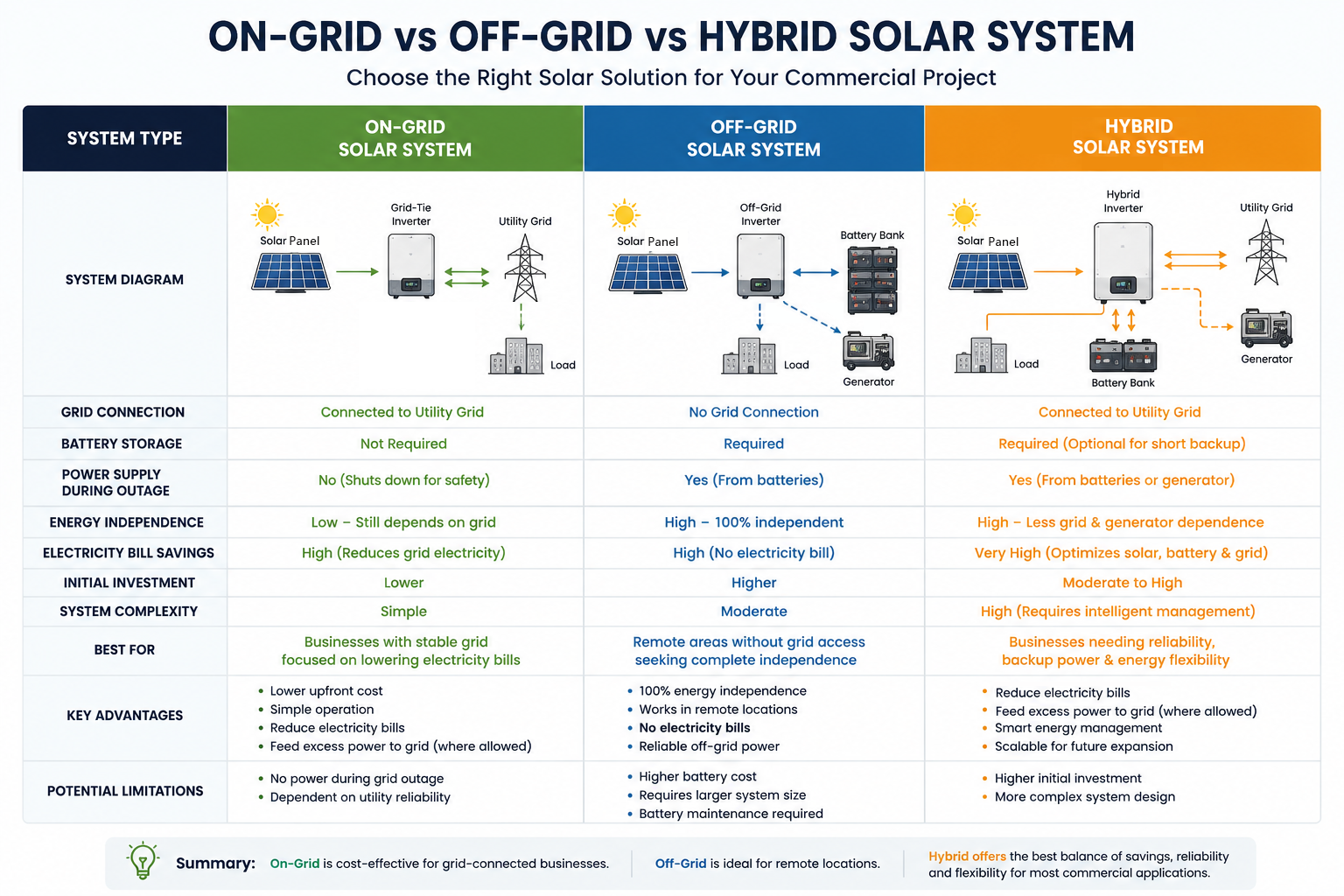
The comparison below highlights the key differences between on-grid, off-grid, and hybrid solar systems.
Quick Comparison
|
Feature |
On-Grid Solar System |
Off-Grid Solar System |
Hybrid Solar System |
|
Connected to Utility Grid |
✔ |
✖ |
✔ |
|
Battery Storage |
Optional |
Required |
Required |
|
Backup During Grid Failure |
No |
Yes |
Yes |
|
Initial Investment |
Low |
High |
Medium to High |
|
Electricity Bill Savings |
Excellent |
Excellent |
Excellent |
|
Diesel Generator Compatibility |
No |
Yes |
Yes |
|
Suitable for Remote Locations |
No |
Excellent |
Excellent |
|
Energy Independence |
Low |
Complete |
High |
|
System Complexity |
Low |
High |
Medium |
|
Long-Term Flexibility |
Medium |
Medium |
Excellent |
Although this table provides a useful overview, choosing the right system requires a deeper understanding of how each solution performs in real commercial environments.
Investment Cost vs Long-Term Value
Many businesses focus primarily on the initial purchase price.
However, experienced project owners evaluate the total cost of ownership (TCO) over the system's entire service life.
An on-grid solar system usually requires the lowest initial investment because it does not rely on large battery storage. This makes it attractive for businesses with reliable utility power and relatively predictable electricity consumption.
An off-grid system requires additional investment in batteries, intelligent controllers, and often a backup generator. While the upfront cost is higher, it eliminates dependence on unstable utility infrastructure and significantly reduces diesel fuel consumption.
A hybrid solar system falls between these two options. Although batteries increase the project cost, the combination of solar generation, battery storage, utility power, and intelligent energy management often delivers the highest long-term financial return for commercial users.
For many businesses, the question should not be, "Which system is the cheapest?" Instead, it should be:
"Which system will generate the greatest value over the next 15 to 25 years?"
Reliability Is Often More Important Than Price
One of the biggest misconceptions in commercial solar is that the least expensive solution provides the best return.
In reality, every hour of downtime has a financial cost.
A factory may lose production.
A hotel may receive guest complaints.
A supermarket risks food spoilage.
A hospital cannot afford interruptions to critical medical equipment.
For these businesses, reliable electricity is far more valuable than saving a small percentage on installation costs.
This is why many commercial customers are moving away from conventional grid-tied systems and investing in hybrid solutions that continue supplying power during outages.
Which System Is Best for Different Types of Businesses?
The right choice depends on how your business consumes electricity.
Office Buildings
Office buildings usually operate during daylight hours when solar generation is highest.
If utility power is reliable, an on-grid solar system often provides the fastest return on investment.
Manufacturing Factories
Factories typically operate heavy machinery, compressors, motors, and production equipment that require stable three-phase electricity.
Unexpected power interruptions may halt production lines, damage equipment, or increase operational costs.
For these facilities, a 3 phase hybrid solar system provides greater operational security while significantly reducing electricity expenses.
Hotels and Resorts
Hotels operate twenty-four hours a day.
Guests expect uninterrupted air conditioning, lighting, elevators, hot water, Wi-Fi, and security systems regardless of external power conditions.
Even a short blackout can negatively affect customer satisfaction and online reviews.
For hospitality businesses, hybrid systems provide an ideal balance between energy savings and operational reliability.
Hospitals and Healthcare Facilities
Hospitals have one of the highest reliability requirements of any commercial building.
Operating rooms, laboratories, intensive care units, and emergency departments cannot tolerate unexpected power failures.
Hybrid systems with battery storage and automatic generator integration provide multiple layers of backup protection while reducing long-term electricity costs.
Agricultural and Industrial Projects
Remote farms, irrigation systems, mining operations, and industrial processing facilities are often located far from stable utility infrastructure.
Depending on local conditions, either an off-grid or hybrid solar system may offer the best balance between reliability and operating costs.
Why Hybrid Systems Are Becoming the Industry Standard
Over the past decade, commercial solar technology has evolved significantly.
Businesses are no longer choosing between only two options.
Instead, many are adopting hybrid systems because they combine the strongest features of both on-grid and off-grid designs.
A modern 3 phase hybrid solar system can:
- Reduce utility electricity consumption during the day.
- Store excess solar energy for nighttime use.
- Continue operating during grid failures.
- Automatically start and stop backup generators.
- Optimize battery charging based on electricity tariffs.
- Support three-phase commercial equipment with stable voltage.
- Expand easily as future energy demand grows.
This flexibility explains why hybrid technology has become increasingly popular in commercial and industrial projects worldwide.
Looking Beyond Today's Electricity Needs
A common mistake businesses make is sizing a solar system solely for current electricity consumption.
In reality, energy demand rarely remains constant.
A hotel may expand its guest rooms.
A factory may install additional production lines.
A warehouse may introduce automated logistics equipment.
Electric vehicle charging stations may become part of future infrastructure.
A well-designed hybrid system allows these future upgrades without requiring a complete redesign of the original installation.
Planning for future growth from the beginning often results in a lower total investment over the lifetime of the project.
The Bottom Line
Each solar solution serves a different purpose.
An on-grid solar system is ideal for businesses with reliable utility power that primarily want to reduce electricity bills.
An off-grid solar system provides complete energy independence for remote locations where utility infrastructure is unavailable.
For many commercial buildings, however, neither option fully addresses modern energy challenges.
A 3 phase hybrid solar system combines the cost-saving benefits of solar power with battery storage, intelligent energy management, and backup power, making it one of the most reliable and future-ready solutions for commercial and industrial applications.
In the next section, we'll examine why businesses across Africa, Southeast Asia, South America, and other emerging markets are increasingly choosing hybrid technology—and what real-world projects can teach us about designing a successful commercial solar installation.
Why a 3 Phase Hybrid Solar System Is Becoming the Preferred Choice for Commercial Buildings
Commercial buildings consume electricity very differently from residential homes.
A family home may only need to power lighting, appliances, and a small air-conditioning unit. By contrast, commercial facilities often operate large motors, industrial equipment, elevators, water pumps, central air-conditioning systems, refrigeration units, production machinery, and other high-power electrical loads simultaneously.
These applications require a stable and balanced three-phase electrical supply.
As businesses become increasingly dependent on uninterrupted electricity, the traditional choice between on-grid and off-grid solar systems is no longer sufficient. Instead, many organizations are turning to 3 phase hybrid solar systems, which combine the cost-saving benefits of solar power with intelligent battery storage and multiple backup energy sources.
For hotels, factories, hospitals, shopping malls, warehouses, schools, and office buildings, this technology has become one of the most practical long-term investments in energy infrastructure.
Designed for Modern Commercial Power Demand
Nearly every medium-sized or large commercial facility operates on a three-phase electrical network.
Unlike residential systems, where electrical demand is relatively stable, commercial buildings experience constantly changing load conditions throughout the day.
For example:
- A hotel may experience peak air-conditioning demand in the afternoon.
- A factory may start multiple production lines at the beginning of each shift.
- A shopping mall experiences its highest electricity consumption during evenings and weekends.
- A hospital must support critical medical equipment twenty-four hours a day.
These dynamic load profiles require a power system capable of responding instantly without affecting operational stability.
A professionally engineered 3 phase hybrid solar system continuously monitors generation, storage, and consumption while automatically balancing power across all three phases.
This ensures stable voltage, efficient energy utilization, and uninterrupted operation for critical equipment.
Supporting Three-Phase Unbalanced Loads
One feature that is often overlooked—but critically important—is the ability to manage three-phase unbalanced loads.
In real commercial buildings, electrical demand is rarely distributed evenly.
For example:
- Commercial kitchens may draw heavily on one phase.
- HVAC systems may primarily operate on another.
- Elevators, pumps, and industrial motors may load the remaining phase.
If an inverter cannot compensate for these differences, businesses may experience:
- Voltage instability
- Reduced equipment lifespan
- Unexpected inverter shutdowns
- Lower energy efficiency
- Increased maintenance costs
High-quality commercial hybrid inverters are specifically designed to support 100% three-phase unbalanced output, allowing equipment to operate safely even when load distribution changes continuously.
For facilities operating around the clock, this capability significantly improves overall system reliability.
Intelligent Energy Management Maximizes Every Kilowatt-Hour
Generating electricity is only part of the equation.
Using that electricity efficiently is equally important.
Modern 3 phase hybrid solar systems integrate an advanced Energy Management System (EMS) that automatically determines the most economical energy source at any given moment.
For example:
- During sunny daytime hours, solar energy powers the building directly.
- Excess electricity charges the battery bank.
- After sunset, batteries supply stored energy to the building.
- During utility outages, batteries and solar continue supporting essential loads.
- If battery capacity becomes low, the diesel generator starts automatically and shuts down once charging is complete.
Because the EMS manages every transition automatically, building occupants experience uninterrupted electricity without manual intervention.
For commercial facilities operating twenty-four hours a day, this intelligent automation reduces operating costs while improving energy security.
Lower Operating Costs Without Sacrificing Reliability
Many businesses initially focus on reducing electricity bills.
However, experienced project owners understand that operational continuity is often even more valuable.
Imagine a hotel losing power during peak tourist season.
A factory stopping production because of a utility failure.
A hospital experiencing interruptions to critical medical equipment.
The financial consequences of these events can far exceed the savings achieved by choosing a lower-cost solar system.
A properly designed 3 phase hybrid solar system addresses both objectives simultaneously.
It minimizes electricity purchases during the day, reduces diesel generator operating hours, stores excess solar energy for later use, and provides reliable backup whenever utility power becomes unavailable.
The result is lower operating costs without compromising business continuity.
Built for Future Business Growth
One of the greatest advantages of commercial hybrid systems is scalability.
Businesses rarely maintain the same electricity demand throughout the life of a building.
Hotels add guest rooms.
Factories install new production lines.
Warehouses introduce automated logistics systems.
Office buildings expand.
Electric vehicle charging stations become increasingly common.
A modular 3 phase hybrid solar system allows additional photovoltaic capacity, battery storage, or inverter capacity to be integrated as energy demand grows.
Planning for expansion from the beginning helps avoid expensive system redesigns in the future while protecting the long-term return on investment.
Ideal Applications for a 3 Phase Hybrid Solar System
Although hybrid technology can be adapted to almost any commercial project, it provides exceptional value in facilities where reliable electricity directly affects daily operations.
Typical applications include:
- Hotels and resorts
- Manufacturing factories
- Food processing plants
- Hospitals and healthcare centers
- Shopping malls
- Commercial office buildings
- Logistics warehouses
- Schools and universities
- Agricultural processing facilities
- Mining operations
- Telecommunications infrastructure
- Government facilities
In each of these environments, uninterrupted electricity is essential for maintaining productivity, protecting equipment, and delivering a consistent customer experience.
A Practical Example from the Hospitality Industry
One hospitality project clearly demonstrates the advantages of hybrid technology.
A hotel located in Papua New Guinea required a reliable power solution capable of supporting approximately 80 air-conditioning units, guest accommodations, restaurants, fitness facilities, and other essential services.
Rather than installing a conventional grid-tied system, engineers designed a 3 phase hybrid solar system with dual battery banks, intelligent energy management, and automatic diesel generator integration.
The system continuously prioritizes solar energy during the day, stores excess electricity in batteries, and automatically switches between battery storage, utility power, and generator backup based on real-time operating conditions.
As a result, the hotel significantly reduced diesel consumption while maintaining uninterrupted electricity for guests—even during prolonged utility interruptions.
The project demonstrates an important principle:
Commercial solar is not simply about generating electricity.
It is about ensuring that businesses continue operating efficiently regardless of external power conditions.
Why Hybrid Systems Represent the Future of Commercial Solar
Across Africa, Southeast Asia, South America, and many island regions, businesses face the same challenge:
Electricity is becoming more expensive, while reliable power remains difficult to guarantee.
Hybrid technology addresses both problems simultaneously.
Instead of depending entirely on the utility grid—or investing in an oversized off-grid system—a 3 phase hybrid solar system intelligently combines solar energy, battery storage, grid electricity, and generator backup into one integrated solution.
This balanced approach delivers lower operating costs, greater energy resilience, improved power quality, and the flexibility to support future business growth.
For many commercial and industrial projects today, the question is no longer whether hybrid technology is worthwhile.
The real question is how to design a hybrid system that matches the facility's operational requirements, electrical load profile, and long-term development plans.
In the next section, we'll examine real commercial projects completed in different regions and explore the practical lessons they offer for businesses planning their own commercial solar installation.
Real Commercial Project Examples: What Successful Installations Can Teach Us
Understanding the differences between on-grid, off-grid, and hybrid solar systems is only the first step. The real value comes from seeing how these technologies perform in actual commercial projects.
Every business has unique operating requirements. A hotel needs uninterrupted power for guest comfort. A factory prioritizes production continuity. A hospital cannot tolerate even a brief interruption to critical medical equipment.
Over the years, Tanfon Solar Energy Systems has completed commercial and industrial projects across Africa, Southeast Asia, the Pacific, and other emerging markets. Although every project is different, they all demonstrate one important principle:
The best solar system is never selected from a catalog—it is engineered around the customer's operational requirements.
The following projects illustrate how this principle is applied in practice.
Case Study 1: A Remote Hotel in Papua New Guinea
One of the most technically demanding hospitality projects involved a hotel in Papua New Guinea.
Unlike urban commercial buildings with reliable grid access, this hotel required continuous electricity for approximately 80 air-conditioning units, guest rooms, restaurants, kitchens, a fitness center, office facilities, and other essential services.
The owner wasn't simply looking for lower electricity bills.
Their primary objective was operational reliability.
During project discussions, the customer provided nearly 60 detailed technical requirements, covering everything from backup operation and charging priority to remote monitoring and maintenance procedures.
Rather than purchasing equipment based solely on specifications, the customer traveled to Tanfon's manufacturing facility and spent several days working alongside our engineers to understand how the entire system would operate under different conditions.
Following a comprehensive load analysis, our engineering team designed a 3 phase hybrid solar system featuring:
- Intelligent hybrid inverters
- Dual independent battery banks
- Advanced Energy Management System (EMS)
- Automatic diesel generator integration
- Remote monitoring platform
One particularly important feature was the dual-battery architecture.
Instead of relying on a single battery bank, the system automatically transfers loads between two independent battery groups. If one battery reaches its minimum discharge level, the second battery immediately assumes the load without interrupting hotel operations.
Only when prolonged poor weather significantly reduces both battery banks does the diesel generator start automatically.
This layered backup strategy dramatically improves operational reliability while minimizing diesel fuel consumption.
Project Insight
Hotels do not purchase electricity—they purchase operational continuity.
A guest rarely notices efficient energy management, but they immediately notice a room without air conditioning or an unexpected power outage.
For hospitality projects, system reliability often creates more long-term value than simply minimizing installation costs.
Case Study 2: Reducing Diesel Dependence for an Island Resort
Island resorts often face one of the highest electricity costs in the tourism industry.
Fuel must be transported over long distances.
Generator maintenance is expensive.
Power interruptions directly affect guest satisfaction.
One resort required a solution capable of reducing diesel consumption without compromising service quality.
Our engineering team designed a hybrid energy solution combining:
- High-efficiency photovoltaic generation
- Commercial battery storage
- Intelligent EMS control
- Automatic generator synchronization
Instead of operating generators continuously throughout the day, solar energy now supplies the majority of daytime demand while simultaneously charging the battery system.
During evening operation, stored energy powers guest facilities before the generator becomes necessary.
As a result, generator operating hours decreased significantly, reducing fuel costs, maintenance requirements, and environmental impact while improving the overall guest experience.
Project Insight
For island projects, the objective is rarely to eliminate diesel entirely.
The smarter approach is reducing generator operation to the absolute minimum while maintaining complete operational reliability.
Case Study 3: Supporting Hotel Operations in Nigeria
Many commercial customers in Nigeria face a familiar challenge:
Utility electricity is available—but not consistently.
Power interruptions can occur multiple times each day, forcing businesses to depend heavily on diesel generators.
For one hotel project, the owner's priorities extended beyond reducing electricity bills.
The hotel required:
- Continuous air conditioning
- Reliable elevators
- Stable kitchen operation
- Security systems
- Guest room power
- Conference facilities
A conventional grid-tied solar system could reduce daytime electricity costs, but it would provide no protection during outages.
A completely off-grid system would require substantially larger battery storage, increasing project costs.
Instead, engineers recommended a 3 phase hybrid solar system that intelligently coordinated solar generation, battery storage, utility electricity, and automatic generator control.
During normal conditions, solar energy powers the hotel while charging the batteries.
When utility power fails, the system immediately switches to battery storage.
Only during extended periods of insufficient solar production does the generator start automatically.
This strategy significantly reduced diesel consumption while ensuring uninterrupted operation throughout the hotel.
Project Insight
Hybrid systems are particularly valuable where grid electricity exists but cannot always be relied upon.
Rather than replacing the utility grid, they complement it, allowing businesses to purchase less electricity while maintaining a dependable backup power strategy.
What These Projects Have in Common
Although these projects were completed in different countries and under different operating conditions, they all followed the same engineering process.
Comprehensive Load Analysis
Every project began with a detailed assessment of electrical demand rather than selecting equipment based solely on building size.
Understanding how electricity is consumed throughout the day is essential for determining the correct photovoltaic capacity, inverter configuration, and battery storage.
Customized System Design
No two commercial facilities operate in exactly the same way.
Hotels prioritize guest comfort.
Factories prioritize production continuity.
Hospitals prioritize patient safety.
Designing each system around the customer's operational priorities results in significantly better long-term performance than using standardized equipment packages.
Intelligent Energy Management
Modern commercial solar installations are no longer simply collections of solar panels and batteries.
Today's systems continuously monitor generation, storage, utility power, and electrical demand to determine the most efficient operating strategy.
This intelligent control is one of the primary reasons why hybrid technology consistently outperforms traditional solar installations in demanding commercial environments.
Experience Matters More Than Equipment Alone
High-quality components are essential, but successful commercial solar projects depend on much more than selecting reputable equipment.
Accurate load calculations.
Professional system integration.
Future expansion planning.
Remote monitoring.
After-sales technical support.
Preventive maintenance.
These engineering decisions determine whether a solar installation continues operating efficiently for decades—or becomes an expensive lesson in poor system design.
That is why experienced engineering partners focus not only on selling equipment but also on designing complete energy solutions that support long-term business growth.
In the next section, we'll explain how businesses can evaluate their own electricity requirements and choose the most appropriate solar system based on operational needs, budget, and future expansion plans.
How to Choose the Right Commercial Solar System
Selecting a commercial solar system is not simply a matter of choosing the largest photovoltaic array or the lowest-priced quotation. Every commercial facility has its own operating profile, electrical demand, and long-term business objectives.
A system that performs exceptionally well for a manufacturing plant may not be suitable for a hotel. Likewise, an installation designed for a warehouse may be unable to support the operational requirements of a hospital or shopping mall.
The most successful commercial solar projects begin with understanding how a business actually uses electricity—not with selecting equipment.
Below are the key factors every business should evaluate before investing in a commercial solar installation.
Step 1: Start with a Professional Load Analysis
Every successful solar project begins with one question:
How much electricity does your business actually use?
Many companies know their monthly electricity bill, but very few understand how power is consumed throughout the day.
A professional load analysis should evaluate:
- Daily energy consumption (kWh)
- Peak demand (kW)
- Three-phase load distribution
- Daytime and nighttime usage patterns
- Seasonal variations
- Critical loads that require uninterrupted power
- Future expansion plans
For example, two hotels may have the same number of guest rooms but very different energy requirements depending on whether they operate central air-conditioning systems, commercial kitchens, swimming pools, conference facilities, or laundry services.
Similarly, two factories with identical floor areas may require completely different solar system capacities because of differences in production equipment and operating schedules.
Accurate load analysis is the foundation of every reliable commercial solar system.
Step 2: Choose the Right System Type
Once the electrical load has been evaluated, the next step is selecting the most appropriate system architecture.
Generally speaking:
On-grid systems are best suited to businesses with stable utility power that primarily want to reduce electricity costs.
Off-grid systems are ideal for remote locations where utility electricity is unavailable.
For many commercial facilities, however, a 3 phase hybrid solar system provides the greatest flexibility by combining solar generation, battery storage, utility power, and optional generator backup into one intelligent energy solution.
Rather than asking which system is "best," businesses should determine which solution best matches their operating conditions.
Step 3: Size the Solar Array Correctly
One of the most common misconceptions is that more solar panels automatically produce a better system.
In reality, photovoltaic capacity should be determined through engineering calculations rather than guesswork.
Several factors influence the required solar array size:
- Average daily electricity consumption
- Local solar irradiance
- Roof or ground installation area
- Module orientation and tilt angle
- Seasonal weather conditions
- Future energy demand
Experienced engineers also account for module degradation over time, ensuring that the system continues delivering reliable performance throughout its expected service life.
Oversizing the array slightly can improve long-term energy production, but excessive oversizing may increase project costs without delivering proportional financial benefits.
Step 4: Don't Underestimate Battery Storage
For hybrid and off-grid projects, battery storage is just as important as the solar panels themselves.
An undersized battery bank may leave the business without sufficient backup power during nighttime operation or prolonged cloudy weather.
An oversized battery bank increases project costs unnecessarily.
Battery capacity should be determined by considering:
- Nighttime electricity demand
- Required backup duration
- Critical equipment
- Generator operating strategy
- Daily charging opportunities
For commercial applications, lithium iron phosphate (LiFePO₄) batteries have become the preferred technology because they combine long service life, high safety, and excellent cycling performance.
A well-designed Battery Energy Storage System (BESS) should support business continuity while maximizing the use of solar energy.
Step 5: Plan for Future Expansion
Many commercial solar systems are designed only for today's electricity demand.
However, businesses evolve.
Hotels add new guest rooms.
Factories install additional machinery.
Warehouses expand storage capacity.
Shopping centers introduce electric vehicle charging stations.
If expansion is not considered during the initial design phase, future upgrades may require replacing inverters, redesigning electrical distribution systems, or rebuilding sections of the solar installation.
Choosing a scalable 3 phase hybrid solar system allows additional photovoltaic capacity, battery storage, and inverter capacity to be integrated with minimal disruption.
Planning ahead often reduces lifetime investment costs while protecting future business growth.
Step 6: Evaluate More Than Equipment
Many buyers compare quotations based only on the specifications of solar panels or battery capacity.
However, equipment alone does not determine project success.
When evaluating a supplier, consider questions such as:
- Does the supplier perform a professional load analysis?
- Can the system be remotely monitored?
- Is local or remote technical support available?
- Are software updates provided?
- Is preventive maintenance included?
- Can the system be expanded in the future?
- Does the supplier have experience with commercial projects similar to yours?
A commercial solar system is expected to operate for decades.
Selecting an experienced engineering partner is often more important than choosing a slightly lower purchase price.
Common Mistakes Businesses Should Avoid
After reviewing hundreds of commercial projects, several design mistakes appear repeatedly.
Choosing Based Only on Price
A lower purchase price does not necessarily produce a lower lifetime operating cost.
Poor-quality equipment, inadequate engineering, and insufficient after-sales support often lead to higher maintenance expenses and unexpected downtime.
Ignoring Load Profiles
Designing a system based only on monthly electricity consumption ignores how electricity is actually used throughout the day.
Load profile analysis is essential for determining inverter capacity, battery storage, and photovoltaic sizing.
Underestimating Battery Capacity
Attempting to reduce project costs by minimizing battery storage often results in excessive generator operation and reduced energy independence.
The battery system should be designed around operational requirements—not budget alone.
Failing to Plan for Business Growth
Commercial buildings rarely maintain the same electricity demand over twenty years.
Designing with future expansion in mind helps avoid expensive modifications later.
Choosing an Inexperienced Supplier
Commercial solar engineering requires expertise in electrical design, system integration, software configuration, commissioning, and long-term maintenance.
The supplier should be evaluated not only by product specifications but also by proven engineering experience.
A Successful Solar Project Starts with Good Engineering
The most successful commercial solar installations are not necessarily the largest or the most expensive.
They are the systems that have been carefully designed around the customer's operational requirements.
By conducting a thorough load analysis, selecting the appropriate system architecture, sizing the photovoltaic array and battery storage correctly, and planning for future expansion, businesses can achieve reliable power, lower operating costs, and stronger long-term returns.
Ultimately, investing in solar energy is not simply about purchasing equipment.
It is about building an energy infrastructure that will support your business for the next twenty years and beyond.
In the next section, we'll explore why businesses in more than 100 countries have chosen Tanfon Solar Energy Systems, and how engineering expertise, global project experience, and long-term technical support contribute to the success of commercial solar installations.
Why Choose Tanfon Solar Energy Systems for Your Commercial Project?
Choosing a commercial solar supplier is about much more than comparing equipment specifications or requesting the lowest quotation.
A commercial solar project is a long-term investment expected to operate reliably for twenty years or more. The success of that investment depends not only on the quality of the equipment, but also on the engineering expertise behind the system design, installation, commissioning, and long-term technical support.
For this reason, experienced businesses evaluate a solar partner based on technical capability, project experience, and after-sales service—not simply product pricing.
This is the philosophy behind Tanfon Solar Energy Systems.
Nearly Two Decades of Commercial Solar Experience
Commercial and industrial solar projects are fundamentally different from residential installations.
Hotels operate twenty-four hours a day.
Factories rely on stable power for production equipment.
Hospitals require uninterrupted electricity for life-critical systems.
Agricultural facilities often operate in remote environments with limited grid access.
Each application presents unique engineering challenges.
Over nearly twenty years, Tanfon Solar Energy Systems has focused on commercial and industrial solar projects, developing solutions for hotels, factories, hospitals, warehouses, schools, shopping centers, agricultural facilities, and government infrastructure.
Rather than offering standardized packages, every project begins with understanding the customer's electrical requirements and business objectives before recommending an appropriate solution.
Engineering Before Equipment
One of the most common mistakes in commercial solar is selecting equipment before understanding the electrical load.
At Tanfon, system design always begins with engineering.
Before recommending photovoltaic capacity, inverter configuration, or battery storage, our engineers evaluate:
- Daily electricity consumption
- Peak demand
- Three-phase load distribution
- Critical backup requirements
- Future expansion plans
- Local solar resources
- Utility grid stability
Only after completing this assessment is a complete system configuration developed.
This engineering-first approach helps avoid both undersized systems that cannot support operational requirements and oversized systems that unnecessarily increase project costs.
Proven Experience Across Diverse Commercial Applications
Every industry uses electricity differently.
Hotels require uninterrupted guest services.
Factories prioritize production continuity.
Hospitals demand maximum reliability.
Warehouses focus on operational efficiency.
Schools seek long-term cost savings.
Because of these differences, experience gained from one type of project cannot always be applied directly to another.
Over the years, Tanfon Solar Energy Systems has delivered projects across Africa, Southeast Asia, the Pacific, the Middle East, and other international markets, providing valuable experience in designing systems for different climates, electrical infrastructures, and operational requirements.
This practical experience enables our engineering team to recommend solutions based on real-world operating conditions rather than theoretical assumptions.
Expertise in 3 Phase Hybrid Solar Systems
As commercial energy requirements continue to evolve, hybrid technology has become one of the fastest-growing segments of the solar industry.
Many modern commercial facilities require:
- Lower electricity costs
- Reliable backup power
- Reduced diesel consumption
- Intelligent energy management
- Flexible future expansion
Meeting all of these objectives requires much more than installing solar panels.
It requires the integration of photovoltaic generation, battery storage, utility power, backup generators, and intelligent control software into one coordinated system.
Designing and optimizing a 3 phase hybrid solar system demands expertise in electrical engineering, system integration, battery management, and automation.
This is where experience makes a measurable difference.
From load balancing and inverter configuration to EMS programming and remote diagnostics, every component must operate as part of a single intelligent energy ecosystem.
Remote Monitoring and Predictive Maintenance
Installing a commercial solar system is only the beginning of its lifecycle.
Maintaining long-term performance requires continuous monitoring and timely technical support.
Modern Tanfon Solar Energy Systems are equipped with intelligent monitoring platforms that allow customers and engineers to view system performance remotely.
Key operational data—including photovoltaic generation, battery state of charge, utility status, load demand, inverter performance, and alarm records—can be monitored in real time through a secure online platform.
This visibility allows potential issues to be identified before they develop into major failures.
Rather than waiting for equipment to stop working, engineers can recommend preventive maintenance based on actual operating data, helping customers maximize system availability while reducing maintenance costs
Designed for Long-Term Reliability
Commercial solar systems operate under demanding conditions.
High temperatures.
Heavy electrical loads.
Frequent load fluctuations.
Harsh outdoor environments.
Long operating hours.
Every design decision influences long-term reliability.
For this reason, commercial projects require more than high-quality components—they require thoughtful system integration, robust protection strategies, and rigorous engineering standards.
By focusing on reliability from the design stage onward, businesses can reduce unexpected downtime, extend equipment life, and achieve a stronger return on investment throughout the system's operating life.
A Long-Term Partnership, Not Just a Equipment Supplier
One of the defining characteristics of successful commercial solar projects is the relationship between the customer and the engineering team after commissioning.
Business requirements evolve.
Electricity demand increases.
Facilities expand.
Software is updated.
Operational priorities change.
A reliable solar partner continues supporting customers throughout these changes.
Whether optimizing system performance, integrating additional battery storage, expanding photovoltaic capacity, or providing technical guidance, long-term collaboration helps ensure that the solar investment continues delivering value year after year.
For many businesses, this ongoing engineering support becomes just as important as the equipment itself.
The Tanfon Approach
Every commercial project is unique.
Instead of promoting a single standard solution, Tanfon Solar Energy Systems focuses on designing systems that match each customer's operational goals, electrical infrastructure, and long-term development plans.
By combining engineering expertise, commercial project experience, intelligent energy management, and comprehensive technical support, the objective is simple:
To deliver reliable, efficient, and scalable solar energy solutions that help businesses reduce operating costs while ensuring uninterrupted operations for years to come.
In the final section of this guide, we'll answer some of the most frequently asked questions about on-grid, off-grid, and hybrid solar systems, and summarize the key considerations for choosing the right commercial solar solution.
Frequently Asked Questions (FAQ)
1. What is the difference between an on-grid, off-grid, and hybrid solar system?
An on-grid solar system is connected to the public utility grid and is primarily designed to reduce electricity bills. It does not provide backup power during a grid outage unless additional backup equipment is installed.
An off-grid solar system operates independently of the utility grid and relies on battery storage to supply electricity whenever solar generation is unavailable. It is commonly used in remote locations without reliable grid access.
A hybrid solar system combines the advantages of both approaches. It integrates solar panels, battery storage, the utility grid, and, if required, a backup generator. This allows businesses to reduce electricity costs while maintaining uninterrupted power during outages.
For most commercial facilities, a 3 phase hybrid solar system offers the best balance of energy savings, operational reliability, and future flexibility.
2. Which solar system is best for a commercial building?
The answer depends on your business requirements.
If your utility grid is stable and your main objective is reducing electricity costs, an on-grid system may be sufficient.
If your site has no utility connection, an off-grid system is usually the best solution.
However, for hotels, factories, hospitals, shopping malls, warehouses, schools, and office buildings where reliable electricity is critical, a 3 phase hybrid solar system is often the preferred choice because it combines solar generation, battery storage, and intelligent energy management.
3. How do I know what size solar system my business needs?
The correct system size should always be determined through a professional load analysis.
Engineers typically evaluate:
- Daily electricity consumption (kWh)
- Peak demand (kW)
- Operating hours
- Critical loads
- Roof or installation area
- Local solar resources
- Future business expansion
Selecting a system based only on monthly electricity bills can result in either oversizing or undersizing the installation.
4. Is battery storage necessary for commercial solar systems?
Not always.
On-grid systems can operate without batteries if backup power is not required.
However, businesses that experience frequent outages—or those where uninterrupted operation is essential—should strongly consider battery storage.
A properly designed Battery Energy Storage System (BESS) improves energy resilience, increases self-consumption of solar energy, and reduces dependence on diesel generators.
5. Why are 3 phase hybrid solar systems popular for commercial projects?
Most commercial buildings operate on three-phase electrical systems and power equipment such as air-conditioning systems, elevators, pumps, industrial machinery, refrigeration units, and production lines.
A 3 phase hybrid solar system is specifically designed to support these applications while managing three-phase unbalanced loads, integrating battery storage, and automatically coordinating solar energy, utility power, and backup generators.
This combination delivers greater reliability and operational flexibility than conventional grid-tied systems.
6. Can a hybrid solar system work with a diesel generator?
Yes.
One of the major advantages of a commercial hybrid system is its ability to integrate seamlessly with existing diesel generators.
The Energy Management System (EMS) can automatically start or stop the generator based on battery state of charge, load demand, and solar generation.
This intelligent control helps reduce fuel consumption, minimize generator operating hours, and extend equipment life.
7. How long do commercial solar systems typically last?
Most commercial photovoltaic modules have a design life of more than 25 years.
Hybrid inverters and battery systems have different service lives depending on operating conditions, maintenance practices, and product quality.
With proper engineering, regular monitoring, and preventive maintenance, a commercial solar installation can deliver reliable performance for decades.
8. Can a commercial solar system be expanded later?
Yes.
Many businesses increase electricity demand over time as they expand production, add buildings, or install new equipment.
A well-designed commercial solar system should allow additional photovoltaic capacity, battery storage, or inverter capacity to be integrated without requiring a complete system redesign.
Planning for future expansion during the initial design phase often reduces long-term investment costs.
9. How much can a commercial solar system reduce electricity costs?
The exact savings depend on several factors, including electricity tariffs, solar resources, system size, battery capacity, and operating patterns.
Many businesses significantly reduce grid electricity purchases during daylight hours, while hybrid systems can further lower diesel fuel consumption and improve energy independence through battery storage.
A detailed financial analysis based on actual energy consumption provides the most accurate estimate of potential savings.
10. Why choose Tanfon Solar Energy Systems?
Choosing a solar partner involves much more than purchasing equipment.
Tanfon Solar Energy Systems focuses on commercial and industrial solar projects, combining engineering-led system design, intelligent energy management, global project experience, and comprehensive technical support.
Rather than offering standardized packages, every solution is designed around the customer's electrical load, operational priorities, and long-term business objectives, helping businesses achieve reliable power, lower operating costs, and scalable energy infrastructure.
Final Thoughts
Choosing the right solar solution is one of the most important energy decisions a business will make.
Whether your priority is lowering electricity costs, reducing diesel consumption, improving energy resilience, or supporting future expansion, the right system begins with a clear understanding of your operational requirements—not simply the equipment itself.
For businesses with reliable utility access, an on-grid system may deliver excellent economic returns. For remote locations without grid infrastructure, an off-grid solution can provide complete energy independence. For many commercial and industrial facilities, however, a 3 phase hybrid solar system offers the most practical balance of efficiency, flexibility, and operational security.
The success of any commercial solar project depends on careful planning, accurate load analysis, professional engineering, and long-term technical support. By working with an experienced engineering partner, businesses can build an energy system that continues delivering value for decades.
If you're evaluating a commercial solar project and want a solution tailored to your facility, the first step is a professional consultation. A detailed assessment of your energy consumption, operating conditions, and future expansion plans will ensure that the system you invest in today continues to support your business well into the future.
Ready to Plan Your Commercial Solar Project?
Whether you're building a new facility or upgrading an existing one, our engineering team can help you determine the most suitable solution for your business.
We can assist with:
- Free preliminary load assessment
- Custom commercial solar system design
- ROI and payback analysis
- Battery storage sizing
3 phase hybrid solar system configuration
Technical consultation for hotels, factories, hospitals, warehouses, schools, and other commercial facilities
Contact Tanfon Solar Energy Systems today to discuss your project with our engineers and discover how a professionally designed commercial solar solution can reduce operating costs while delivering reliable, long-term energy performance.
Table of Contents
- What Is the Difference Between On-Grid and Off-Grid Solar?
- Understanding the Three Main Types of Solar Energy Systems
- What Is an On-Grid Solar System?
- How Does an On-Grid Solar System Work?
- Advantages of an On-Grid Solar System
- Limitations of an On-Grid Solar System
- Where Is an On-Grid Solar System the Best Choice?
- When an On-Grid Solar System May Not Be Enough
- What Is an Off-Grid Solar System?
- How Does an Off-Grid Solar System Work?
- Advantages of an Off-Grid Solar System
- Challenges of an Off-Grid Solar System
- Typical Commercial Applications
- Real-World Example
- Is an Off-Grid Solar System Always the Best Choice?
- What Is a Hybrid Solar System?
- How Does a Hybrid Solar System Work?
- Why Businesses Are Choosing a 3 Phase Hybrid Solar System
- Key Components of a Commercial Hybrid Solar System
- High-Efficiency Solar Panels
- Hybrid Solar Inverter
- Battery Energy Storage System (BESS)
- Energy Management System (EMS)
- Advantages of a Hybrid Solar System for Commercial Buildings
- Significant Electricity Cost Savings
- Continuous Business Operations
- Greater Return on Investment
- Future Expansion
- Is a Hybrid Solar System Right for Your Business?
- On-Grid vs Off-Grid vs Hybrid Solar Systems: Which Is Best for Your Business?
- Quick Comparison
- Investment Cost vs Long-Term Value
- Reliability Is Often More Important Than Price
- Which System Is Best for Different Types of Businesses?
- Why Hybrid Systems Are Becoming the Industry Standard
- Looking Beyond Today's Electricity Needs
- The Bottom Line
- Why a 3 Phase Hybrid Solar System Is Becoming the Preferred Choice for Commercial Buildings
- Designed for Modern Commercial Power Demand
- Supporting Three-Phase Unbalanced Loads
- Intelligent Energy Management Maximizes Every Kilowatt-Hour
- Lower Operating Costs Without Sacrificing Reliability
- Built for Future Business Growth
- Ideal Applications for a 3 Phase Hybrid Solar System
- A Practical Example from the Hospitality Industry
- Why Hybrid Systems Represent the Future of Commercial Solar
- Real Commercial Project Examples: What Successful Installations Can Teach Us
- Case Study 1: A Remote Hotel in Papua New Guinea
- Case Study 2: Reducing Diesel Dependence for an Island Resort
- Case Study 3: Supporting Hotel Operations in Nigeria
- What These Projects Have in Common
- Experience Matters More Than Equipment Alone
- How to Choose the Right Commercial Solar System
- Step 1: Start with a Professional Load Analysis
- Step 2: Choose the Right System Type
- Step 3: Size the Solar Array Correctly
- Step 4: Don't Underestimate Battery Storage
- Step 5: Plan for Future Expansion
- Step 6: Evaluate More Than Equipment
- Common Mistakes Businesses Should Avoid
- A Successful Solar Project Starts with Good Engineering
- Why Choose Tanfon Solar Energy Systems for Your Commercial Project?
- Nearly Two Decades of Commercial Solar Experience
- Engineering Before Equipment
- Proven Experience Across Diverse Commercial Applications
- Expertise in 3 Phase Hybrid Solar Systems
- Remote Monitoring and Predictive Maintenance
- Designed for Long-Term Reliability
- A Long-Term Partnership, Not Just a Equipment Supplier
- The Tanfon Approach
- Frequently Asked Questions (FAQ)
- 1. What is the difference between an on-grid, off-grid, and hybrid solar system?
- 2. Which solar system is best for a commercial building?
- 3. How do I know what size solar system my business needs?
- 4. Is battery storage necessary for commercial solar systems?
- 5. Why are 3 phase hybrid solar systems popular for commercial projects?
- 6. Can a hybrid solar system work with a diesel generator?
- 7. How long do commercial solar systems typically last?
- 8. Can a commercial solar system be expanded later?
- 9. How much can a commercial solar system reduce electricity costs?
- 10. Why choose Tanfon Solar Energy Systems?
- Final Thoughts
- Ready to Plan Your Commercial Solar Project?
