
 EN
EN
Betrouwbare elektriciteit is essentieel voor moderne landbouwbedrijven, vooral wanneer bewatering afhankelijk is van elektrische pompen en waterbeheersapparatuur. Voor veel boerderijen kan bewatering een aanzienlijk deel van het totale energieverbruik vertegenwoordigen, omdat pompen mogelijk meerdere uren per dag moeten draaien, soms tijdens perioden waarin het stroomnet onbetrouwbaar is of dieselbrandstof duur.
Dit heeft zonne-energie tot een steeds aantrekkelijkere optie gemaakt voor landbouwbewatering.
Echter is het bepalen van de juiste omvang van een zonnesysteem niet zo eenvoudig als het kiezen van een bepaald aantal zonnepanelen. Een goed ontworpen zonnewaterpompsysteem moet rekening houden met de capaciteit van de irrigatiepomp, de waterbehoefte, het bedrijfsschema, de lokale zonvoorwaarden, de vereisten voor batterijopslag en toekomstige landbouwontwikkeling. .
Voor boerderijen in afgelegen of net-onafhankelijke gebieden is de uitdaging nog groter. Het systeem moet betrouwbare stroom leveren zonder ondersteuning van het openbare elektriciteitsnet, terwijl het tegelijkertijd irrigatie moet blijven mogelijk maken tijdens perioden met lage zonopbrengst.
Dit is waar een goed geïngineerd 500 kW-zonne-energiesysteem , kleiner zonnewaterpompsysteem of een combinatie van zonne-energie en opslag een praktische oplossing kan bieden, afhankelijk van de schaal van de landbouwactiviteit.
Bij Tanfon richten we ons bij het dimensioneren van landbouwzonneprojecten op de werkelijke elektrische en operationele behoeften, in plaats van te vertrouwen op standaardconfiguraties.
Waarom zonne-energie steeds populairder wordt voor landbouwirrigatie
Landbouw is afhankelijk van een betrouwbare watervoorziening, en irrigatiesystemen behoren vaak tot de meest energie-intensieve belastingen op een boerderij.
Traditionele stroombronnen zoals het elektriciteitsnet en dieselgeneratoren kunnen verschillende uitdagingen opleggen:
- Stijgende elektriciteits- en brandstofkosten
- Onstabiele stroomvoorziening via het net
- Hoge onderhoudseisen voor generatoren
- Moeilijkheden bij het vervoer van brandstof naar afgelegen gebieden
- Geluid en emissies van dieselgeneratoren
- Stijgende bedrijfskosten naarmate de landbouwproductie uitbreidt
Zonne-energie biedt een alternatief door boerderijen in staat te stellen elektriciteit lokaal op te wekken.
Een zonne-energiesysteem kan irrigatiepompen, waterzuiveringsapparatuur, landbouwmachines, verlichting, koeling, boerderijgebouwen en andere elektrische belastingen van stroom voorzien.
Irrigatie heeft echter een unieke eigenschap: de benodigde hoeveelheid elektriciteit hangt direct af van de hoeveelheid water die moet worden verplaatst en van de omstandigheden waaronder het moet worden opgepompt.
Dit betekent dat het zonnesysteem rond de irrigatietoepassing moet worden ontworpen, in plaats van eenvoudigweg rond het beschikbare installatiegebied.
Voor boerderijen die buiten de piekuren van zonlicht irrigatie nodig hebben, kan batterijopslag de flexibiliteit van het systeem verder verbeteren. Overtollige zonne-energie die overdag wordt opgewekt, kan worden opgeslagen en later worden gebruikt, waardoor het irrigatieschema minder afhankelijk is van de actuele zonne-energieproductie.
Wat bepaalt de grootte van een zonne-irrigatiesysteem?
Er bestaat geen enkel zonnesysteem van één vaste grootte dat voor elke boerderij geschikt is.
De benodigde capaciteit hangt af van diverse technische en operationele factoren.
1. Vermogen van de irrigatiepomp
De irrigatiepomp is meestal een van de belangrijkste elektrische belastingen in een landbouwkundig zonne-energieproject.
Ingenieurs moeten bepalen:
- Nominaal vermogen van de pomp
- Motorspanning
- Driefasige of enkelfasige configuratie
- Opstartkenmerken
- Dagelijks bedrijfsuren
- Aantal pompen
- Of pompen gelijktijdig werken
- Vereiste waterdebiet
- Vereiste opvoerhoogte
Bijvoorbeeld kan een boerderij met één relatief kleine irrigatiepomp een geheel ander systeem vereisen dan een grote landbouwbedrijf met meerdere hoogvermogenspompen die gelijktijdig draaien.
De opstartkenmerken van pompen zijn bijzonder belangrijk.
Een motor kan tijdens het opstarten aanzienlijk meer vermogen vereisen dan tijdens normaal bedrijf. Daarom moet de omvormer niet alleen worden geselecteerd op basis van het nominale bedrijfsvermogen van de pomp, maar ook op basis van de opstart- en bedrijfskenmerken ervan.
Dit is één reden waarom het simpelweg afstemmen van de grootte van de zonnepanelenopstelling op de nominaal vermelde waarde van de pomp kan leiden tot een onjuist ontworpen systeem.
2. Waterbehoefte en irrigatieschema
Het elektrisch vermogen dat nodig is, hangt nauw samen met de waterbehoefte.
Verschillende gewassen hebben verschillende irrigatiepatronen nodig. Tuinbouwbedrijven, graanbedrijven, boomgaarden, kwekerijen en grootschalige landbouwprojecten kunnen zeer uiteenlopende waterbehoefte hebben.
Ingenieurs moeten daarom begrijpen:
- De benodigde dagelijkse watervolume
- De frequentie van irrigatie
- De duur van irrigatie
- Seizoensgebonden veranderingen in de waterbehoefte
- Waterbron
- De afstand waarover het water moet worden opgepompt
- Vereiste Waterdruk
- Opbergtankcapaciteit
Een landbouwbedrijf kan bijvoorbeeld tijdens een bepaalde groeiperiode intensieve irrigatie nodig hebben, maar aanzienlijk minder water tijdens andere seizoenen.
Dit heeft gevolgen voor zowel de benodigde zonnegeneratiecapaciteit als de hoeveelheid batterijopslag die mogelijk nodig is.
Een goed ontworpen zonne-irrigatiesysteem moet daarom gebaseerd zijn op energievraag die voortkomt uit de werkelijke waterbehoefte , in plaats van eenvoudigweg een grotere fotovoltaïsche (PV) installatie te kiezen.
3. Zonnestraling en locatievoorwaarden
Zonne-energieopwekking is sterk afhankelijk van de locatie.
Een boerderij in een regio met sterke, het hele jaar door aanwezige zonnestraling kan mogelijk de benodigde energie opwekken met een kleinere PV-installatie dan een boerderij die aanzienlijke seizoensgebonden variaties in zonnestraling ervaart.
De locatiebeoordeling dient rekening te houden met:
- Gemiddelde zonnestraling
- Pieksunuren
- Seizoengebonden weerspatronen
- Regenval
- Temperatuur
- Schaduw
- Beschikbare grond- of dakoppervlakte
- Oriëntatie en hellingshoek van de panelen
- Milieumomstandigheden
Voor landbouwprojecten zijn op de grond gemonteerde fotovoltaïsche systemen vaak een optie wanneer voldoende grond beschikbaar is.
De beschikbare ruimte alleen mag echter niet bepalen hoe groot het systeem wordt.
Een groot stuk grond betekent niet automatisch dat de boerderij een grote zonnepaneleninstallatie nodig heeft.
Het systeem moet eerst worden afgestemd op de elektriciteitsvraag en daarna geoptimaliseerd op basis van het beschikbare installatiegebied.
4. Dagelijkse bedrijfsuren
Het aantal uren dat het irrigatiesysteem elke dag draait, heeft direct invloed op de energiebehoefte.
Bijvoorbeeld: een irrigatiepomp met een vermogen van 100 kW.
Als deze vier uur per dag draait, bedraagt de basale dagelijkse energiebehoefte ongeveer:
Dit is slechts een vereenvoudigde berekening. Bij de werkelijke dimensionering van het systeem moeten ook rekening worden gehouden met de omvormerefficiëntie, de pompefficiëntie, systeemverliezen, zonopwekkingsomstandigheden, verliezen bij het laden en ontladen van accu’s, en andere elektrische belastingen.
Toch illustreert dit waarom de pompsvermogen alleen niet kan bepalen hoe groot een zonne-irrigatiesysteem moet zijn.
De vraag is niet eenvoudigweg:
“Hoeveel kilowatt is de pomp?”
De belangrijkere vraag is:
“Hoeveel energie heeft het irrigatiesysteem elke dag nodig, en wanneer heeft het die energie nodig?”
Dat onderscheid is fundamenteel voor professioneel ontwerp van zonnesystemen.
Hoe batterijopslag de prestaties van zonne-irrigatie verbetert
Zonne-energieproductie varieert van nature gedurende de dag, terwijl de irrigatiebehoeften niet altijd samenvallen met de piek in zonne-energieproductie.
Sommige boerderijen moeten de irrigatiepompen mogelijk gebruiken:
- Vroeg in de ochtend
- Laat in de namiddag
- Tijdens bewolkte perioden
- ’s Nachts
- Volgens specifieke gewasbeheerplannen
Batterijopslag biedt een manier om het tijdstip van zonne-energieopwekking te scheiden van het tijdstip van elektriciteitsverbruik.
Tijdens perioden met sterke zonneschijn kan de zonnepaneleninstallatie de irrigatielasten voorzien en tegelijkertijd de batterij opladen met overtollige energie.
Later kan de opgeslagen energie worden gebruikt voor irrigatie of andere kritieke landbouwbelastingen.
Dit maakt een zonne-energiesysteem met batterijopslag flexibeler dan een puur fotovoltaïsch systeem.
Batterijopslag kan ook extra veerkracht bieden wanneer de boerderij in een gebied met onbetrouwbare netstroom of zonder aansluiting op het elektriciteitsnet werkt.
Voor off-grid landbouwprojecten kan de algehele architectuur daarom bestaan uit:
Solar PV + Battery Storage + Hybrid Inverter + Diesel Generator Backup
De exacte configuratie hangt af van het belastingsprofiel van de boerderij en de betrouwbaarheidseisen.
Welke accucapaciteit heeft een boerderij nodig?
De accucapaciteit moet worden berekend op basis van de werkelijke energiebehoefte, in plaats van te worden gekozen als een vast percentage van de zonnecapaciteit.
Belangrijke factoren zijn onder andere:
- Vereiste back-upduur
- Kritieke landbouwbelastingen
- Elektriciteitsverbruik ’s nachts
- Zonnestroomopwekkingsprofiel
- Diepte van ontlading van de accu
- Batterij Efficiëntie
- Verwachte bedrijfscycli
- Seizoensgebonden energiebehoeften
Bijvoorbeeld kan een boerderij die slechts enkele uren noodstroom voor kritieke belastingen nodig heeft, aanzienlijk minder accucapaciteit vereisen dan een landbouwinstallatie die ’s nachts in bedrijf moet blijven.
Voor grotere projecten kan een containeriseerd energieopslagsysteem worden overwogen wanneer een aanzienlijke accucapaciteit vereist is.
Een containeroplossing kan batterijmodules, batterijbeheersystemen, thermisch beheer, brandbeveiliging, vermoezelsingsapparatuur en andere componenten integreren in een gecentraliseerde energieopslagarchitectuur.
Dit kan met name nuttig zijn voor grote landbouwprojecten, afgelegen boerderijen en andere toepassingen waar schaalbare energieopslag vereist is.
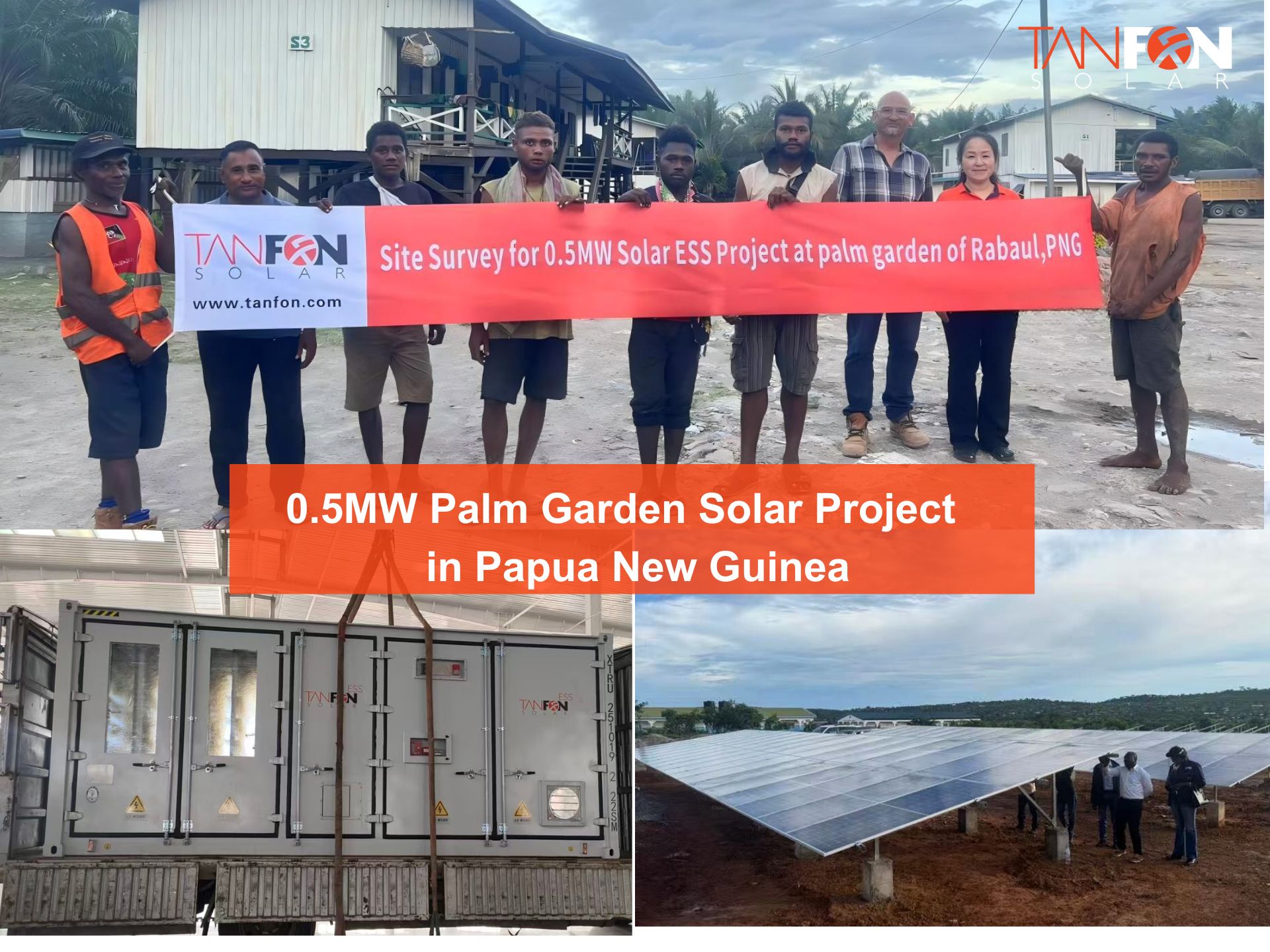
Een voorbeeld uit de praktijk: 500 kW zonneparkinstallatie in Papoea-Nieuw-Guinea
Een praktisch voorbeeld uit onze ervaring met landbouwprojecten komt uit Morehead, Papoea-Nieuw-Guinea , waar Tanfon een zonnestroominstallatie leverde voor een landbouwopleidingscentrum.
De locatie bevond zich in een afgelegen buitenwijk zonder toegang tot het openbare elektriciteitsnet. Voorafgaand aan het project was de faciliteit aangewezen op een 65 kVA dieselgenerator om elektriciteit te leveren voor het studentenhuis, de landbouwopleidingsfaciliteiten, verlichting en waterleidingapparatuur.
De klant stond voor diverse uitdagingen, waaronder hoge brandstofkosten, onderhoud van de generator, lawaai en onstabiele langetermijnenergiekosten.
In plaats van eenvoudigweg de generator te vervangen door een fotovoltaïsche (PV) installatie, ontwierpen we een geïntegreerd hybridesysteem.
De uiteindelijke configuratie omvatte:
- 500 kW hybride zonneparkinstallatie
- 430 kWh LiFePO4-batterijopslag
- 352 × 600 W zonnepanelen
- 500 kW MPS hybride omvormersysteem
- Intelligent Energiemanagementsysteem
- Reserve dieselgenerator
- Off-grid-configuratie voor landbouwtoepassingen
Dit project illustreert een belangrijk principe in zonne-energieontwerp voor landbouw:
De zonnestroominstallatie, de batterijopslag, de omvormer en de noodgenerator moeten als één gecoördineerd energiesysteem worden ontworpen.
Tijdens zonnige omstandigheden kan de zonnestroominstallatie de dagelijkse elektriciteitsbehoefte van de faciliteit volledig dekken, waardoor het landbouwcentrum zonder de dieselmotor kan functioneren.
Tijdens regenachtig of bewolkt weer levert de dieselmotor automatisch noodondersteuning om de continuïteit van de stroomvoorziening te waarborgen.
Het project realiseerde 24-uurs zonne-energiebedrijf tijdens zonnige omstandigheden, verminderde het dieselverbruik en de draaitijd van de generator, en verbeterde de algehele energieduurzaamheid van de faciliteit. Op de projectpagina wordt een geschatte terugverdientijd van ongeveer twee jaar vermeld.
Dit is een goed voorbeeld van waarom landbouwzonneprojecten niet alleen op basis van het fotovoltaïsche vermogen mogen worden ontworpen.
Het systeem werd ontworpen op basis van de daadwerkelijke operationele vereisten van de boerderij en het opleidingscentrum, waarbij batterijopslag en een dieselback-up extra flexibiliteit bieden wanneer de zonne-energieproductie ontoereikend is.
Waarom een zonne-energiesysteem van 500 kW niet altijd hetzelfde is
Het project in Papoea-Nieuw-Guinea levert nog een andere belangrijke les op.
Twee boerderijen kunnen beide een 500 kW-zonne-energiesysteem installeren, maar hun daadwerkelijke systeemconfiguraties kunnen volledig verschillen.
De ene boerderij heeft mogelijk nodig:
500 kW PV + 200 kWh batterij
terwijl de andere boerderij vereist:
500 kW PV + 430 kWh batterij + dieselback-up
Het verschil hangt af van:
- Dagelijks energieverbruik
- Belastingsprofiel
- Bewateringsvereisten
- Beschikbaarheid van het net
- Vereiste back-upduur
- Weersomstandigheden
- Kritieke belastingen
- Toekomstige uitbreiding
Daarom beschrijft “500 kW” de nominale vermogenscapaciteit van een systeemcomponent, maar beschrijft dit op zich niet de volledige energieoplossing.
Voor landbouwprojecten is de relatie tussen PV-capaciteit, omvormercapaciteit, batterijcapaciteit en belastingsvraag veel belangrijker dan de opschriftgrootte van het systeem.
Hoe kiest u tussen een puur PV-systeem en een zonne-energie-plus-opslagsysteem?
Een puur PV-systeem kan geschikt zijn wanneer bewatering voornamelijk overdag kan worden gepland en de boerderij voldoende zonnepotentieel heeft.
Een zonne-energie-plus-opslagsysteem kan geschikter zijn wanneer:
- Bewatering na zonsondergang moet doorgaan
- Het stroomnet is onbetrouwbaar
- De boerderij gebruikt kritische elektrische apparatuur
- Zonne-energie moet worden verschoven naar latere uren
- Reservevermogen is vereist
- De locatie is volledig afgekoppeld van het elektriciteitsnet
Voor afgelegen landbouwprojecten kan een combinatie van zonne-energie, batterijopslag en een noodstroomgenerator een praktisch evenwicht bieden tussen het gebruik van hernieuwbare energie en stroombetrouwbaarheid.
Het landbouwopleidingscentrum in Papoea-Nieuw-Guinea is een goed voorbeeld van deze aanpak. Het systeem gebruikt zonne-energie als primaire energiebron, batterijopslag om de energiebeschikbaarheid te verbeteren en een dieselgenerator als back-up tijdens ongunstige weersomstandigheden.
Waarom een gecontaineriseerd energieopslagsysteem grote boerderijen kan ten goede komen
Naarmate landbouwbedrijven groter worden, kunnen ook hun elektriciteitsbehoeften toenemen.
Grote boerderijen hebben mogelijk elektriciteit nodig voor:
- Meerdere irrigatiepompen
- Waterbehandeling
- Koeling
- Koude opslag
- Landbouwverwerking
- Werkshops
- Werknemers accommodatie
- Verlichting
- Communicatiesystemen
In deze toepassingen kan een containeriseerd energieopslagsysteem een schaalbare aanpak voor batterijopslag bieden.
Vergeleken met kleinere, gedistribueerde batterijinstallaties kan een gecontaineriseerd BESS de energieopslagapparatuur centraliseren en de systeemintegratie voor grotere projecten vereenvoudigen.
Afhankelijk van de projectvereisten kan een gecontaineriseerd energiesysteem integreren:
- LiFePO4-batterijmodules
- BATTERIJBEHEERSYSTEEM
- Energieomzettingsysteem
- Thermisch beheer
- Brandbescherming
- Energiebeheersysteem
- Bewakings- en communicatieapparatuur
Dit type configuratie is bijzonder relevant voor grote off-grid-landbouwfaciliteiten waar een aanzienlijke energieopslagcapaciteit vereist is.
Het belang van de keuze van de omvormer voor irrigatiepompen
De omvormer is een andere cruciale component in een zonne-irrigatiesysteem.
Irrigatiepompen gebruiken vaak asynchrone motoren of andere motoraangedreven apparatuur met aanzienlijke startvereisten.
Daarom moeten ingenieurs het volgende beoordelen:
- Genaamd vermogen motor
- STARTSTROOM
- Motortype
- Spanning
- Faseconfiguratie
- Frequentieveranderende werking
- Werkprofiel van de pomp
Een goed gekozen omvormer moet in staat zijn om de werkelijke elektrische kenmerken van de pomp te verwerken, in plaats van simpelweg overeen te komen met het nominale kW-vermogen van de pomp.
Voor grotere landbouwsystemen kunnen hybride omvormers zonnestroomopwekking, batterijladen, stroom uit het elektriciteitsnet en back-up via een generator coördineren.
Dit creëert een flexibelere bedrijfsarchitectuur en stelt het systeem in staat om adequaat te reageren op wisselende zon- en belastingsomstandigheden.
Waarom professionele systeemdimensionering belangrijk is
Een veelgemaakte fout bij landbouwprojecten met zonne-energie is om de systeemgrootte uitsluitend te bepalen op basis van het aantal zonnepanelen dat op de beschikbare grond past.
Deze aanpak kan leiden tot onderschaling of onnodige overschaling.
Een te klein systeem kan tijdens perioden van hoge vraag mogelijk niet voldoen aan de irrigatiebehoeften.
Een te groot systeem kan de initiële investering verhogen zonder evenredige voordelen op te leveren.
Professionele systeemdimensionering moet daarom een gestructureerd proces volgen:
Stap 1: Beoordeel de elektrische belastingen
Identificeer pompen, motoren, verlichting, koeling, watervoorzieningen en andere elektrische apparatuur.
Stap 2: Analyseer de bedrijfstijden
Bepaal wanneer elke belasting actief is en hoe lang deze dagelijks draait.
Stap 3: Bereken de dagelijkse energievraag
Schat de totale dagelijkse kWh-behoefte.
Stap 4: Evalueer de zonnemogelijkheden
Analyseer de lokale zonnestraling en seizoensgebonden omstandigheden.
Stap 5: Bepaal het PV-vermogen
Selecteer een geschikte zonnepanelenopstelling op basis van de energievraag en de verwachte opwekking.
Stap 6: Bepaal de batterijcapaciteit
Bereken hoeveel energie moet worden opgeslagen en gedurende welke periode.
Stap 7: Selecteer de omvormer
Houd rekening met zowel het continue belastingsvermogen als de vereisten voor het opstarten van motoren.
Stap 8: Integreer noodstroomvoorziening
Bepaal of het project een koppeling met het elektriciteitsnet of een dieselgenerator als back-up vereist.
Dit proces leidt tot een systeem dat is gebaseerd op werkelijke bedrijfsomstandigheden in plaats van aannames.
Kies de juiste zonne-energiepartner voor landbouwprojecten
Zonne-irrigatie omvat veel meer dan het kopen van fotovoltaïsche modules.
De langetermijnprestaties van het systeem hangen af van:
- Een juiste belastingsanalyse
- Apparatuurcompatibiliteit
- Een correct dimensioneren van de omvormer
- Batterijconfiguratie
- Milieumomstandigheden
- Installatiekwaliteit
- Monitoring
- Onderhoud
- Technische Ondersteuning
Voor landbouwprojecten is betrouwbaarheid bijzonder belangrijk, omdat storingen in de irrigatie direct van invloed kunnen zijn op gewasproductie en waterbeheer.
Een leverancier moet daarom niet alleen zonne-energieapparatuur begrijpen, maar ook de operationele vereisten van de landbouwtoepassing.
Bij Tanfon omvatten onze landbouwprojecten verschillende werkomgevingen, van afgelegen netonafhankelijke boerderijen tot grotere toepassingen met zonne-energie en opslag.
Het project in Papoea-Nieuw-Guinea illustreert onze aanpak: in plaats van te vertrouwen op één energiebron integreert het systeem zonnegeneratie, lithiumbatterijopslag, intelligente energiebeheersing en een dieselreserve, afgestemd op de werkelijke eisen van de locatie.
Slotbeschouwing
De vraag “Welke omvang moet het zonnesysteem hebben voor landbouwirrigatie?” kan niet worden beantwoord door alleen naar het pompp vermogen of de beschikbare grondoppervlakte te kijken.
De juiste systeemomvang hangt af van het volledige energieprofiel van de landbouwbedrijfsvoering.
Ingenieurs moeten rekening houden met:
- Pompvermogen
- Waterbehoefte
- Bedrijfstijden
- Zonnepotentieel
- Dagelijks energieverbruik
- Accu-eisen
- Reserve-energie
- Toekomstige uitbreiding van de landbouwactiviteiten
Voor een kleiner boerderij kan de geschikte oplossing een relatief compact zonne-irrigatiesysteem zijn.
Voor een groot landbouwbedrijf kan de behoefte toenemen tot een 500 kW-zonne-energiesysteem gecombineerd met aanzienlijke batterijopslag en back-upgeneratie.
Voor projecten die aanzienlijke energieopslag vereisen, kan een containeriseerd energieopslagsysteem een schaalbare architectuur bieden.
En waar betrouwbare elektriciteit ook buiten de daglichturen nodig is, een 500 kW-zonnesysteem met batterijopslag kan aanzienlijk meer operationele flexibiliteit bieden dan een puur fotovoltaïsche installatie.
De belangrijkste les is eenvoudig:
Het beste landbouwkundige zonnesysteem is niet noodzakelijkerwijs het grootste systeem. Het is het systeem dat correct is afgestemd op de werkelijke energie-, irrigatie- en operationele behoeften van de boerderij.
Met een juiste engineering kan zonne-energie de afhankelijkheid van diesel en elektriciteit uit het net verminderen, terwijl tegelijkertijd een betrouwbaardere en duurzamere stroombron wordt geboden voor moderne landbouw.
Veelgestelde vragen
Hoeveel zonnepanelen zijn er nodig voor een boerderijirrigatiesysteem?
Het aantal panelen hangt af van de vereiste PV-capaciteit, het vermogen per paneel, de lokale zonlichtomstandigheden, systeemverliezen en het dagelijkse energieverbruik voor irrigatie. Een professionele belasting- en zonresourceanalyse dient te worden uitgevoerd voordat het uiteindelijke aantal panelen wordt bepaald.
Is een 500 kW-zonne-energiesysteem geschikt voor een boerderij?
Een zonne-energiesysteem van 500 kW kan geschikt zijn voor grote landbouwbedrijven met een aanzienlijke elektriciteitsvraag, meerdere pompen, verwerkingsapparatuur of andere hoogvermogende belastingen. De juiste capaciteit moet worden bepaald via een gedetailleerde belastingsanalyse.
Wat is een zonne-energiesysteem van 500 kW met batterijopslag?
Een 500 kW-zonnesysteem met batterijopslag combineert een zonne-energiesysteem van de klasse 500 kW met batterijen die overtollige energie opslaan voor later gebruik. De batterijcapaciteit is een afzonderlijke ontwerpparameter en moet worden berekend op basis van de gewenste back-upduur en het energieverbruik.
Wat is een containergebaseerd energiesysteemopslagsysteem?
Een containeriseerd energieopslagsysteem is een geïntegreerde batterijopslagoplossing verpakt in een containerbehuizing. Het kan batterijen, een BMS, vermoeconverterapparatuur, thermisch beheer, brandbeveiliging en energiebeheersystemen omvatten.
Kan zonne-energie dieselgeneratoren op boerderijen vervangen?
In sommige toepassingen kan zonne-energie het routinegebruik van dieselgeneratoren tijdens perioden met voldoende zonneproductie aanzienlijk verminderen of zelfs volledig elimineren. Voor afgelegen of netonafhankelijke boerderijen kan een hybridesysteem met batterijopslag en dieselback-up meer betrouwbaarheid bieden tijdens bewolkte of regenachtige omstandigheden.
Verbeterd batterijopslag de zonne-irrigatie?
Ja. Batterijopslag maakt het mogelijk om overtollige zonne-elektriciteit, die wordt opgewekt tijdens perioden met hoge productie, op te slaan en later te gebruiken. Dit is bijzonder nuttig wanneer de irrigatieschema’s niet perfect samenvallen met de zonneproductie.
Inhoudsopgave
- Waarom zonne-energie steeds populairder wordt voor landbouwirrigatie
- Wat bepaalt de grootte van een zonne-irrigatiesysteem?
- 1. Vermogen van de irrigatiepomp
- 2. Waterbehoefte en irrigatieschema
- 3. Zonnestraling en locatievoorwaarden
- 4. Dagelijkse bedrijfsuren
- Hoe batterijopslag de prestaties van zonne-irrigatie verbetert
- Welke accucapaciteit heeft een boerderij nodig?
- Een voorbeeld uit de praktijk: 500 kW zonneparkinstallatie in Papoea-Nieuw-Guinea
- Waarom een zonne-energiesysteem van 500 kW niet altijd hetzelfde is
- Hoe kiest u tussen een puur PV-systeem en een zonne-energie-plus-opslagsysteem?
- Waarom een gecontaineriseerd energieopslagsysteem grote boerderijen kan ten goede komen
- Het belang van de keuze van de omvormer voor irrigatiepompen
-
Waarom professionele systeemdimensionering belangrijk is
- Stap 1: Beoordeel de elektrische belastingen
- Stap 2: Analyseer de bedrijfstijden
- Stap 3: Bereken de dagelijkse energievraag
- Stap 4: Evalueer de zonnemogelijkheden
- Stap 5: Bepaal het PV-vermogen
- Stap 6: Bepaal de batterijcapaciteit
- Stap 7: Selecteer de omvormer
- Stap 8: Integreer noodstroomvoorziening
- Kies de juiste zonne-energiepartner voor landbouwprojecten
- Slotbeschouwing
-
Veelgestelde vragen
- Hoeveel zonnepanelen zijn er nodig voor een boerderijirrigatiesysteem?
- Is een 500 kW-zonne-energiesysteem geschikt voor een boerderij?
- Wat is een zonne-energiesysteem van 500 kW met batterijopslag?
- Wat is een containergebaseerd energiesysteemopslagsysteem?
- Kan zonne-energie dieselgeneratoren op boerderijen vervangen?
- Verbeterd batterijopslag de zonne-irrigatie?
